
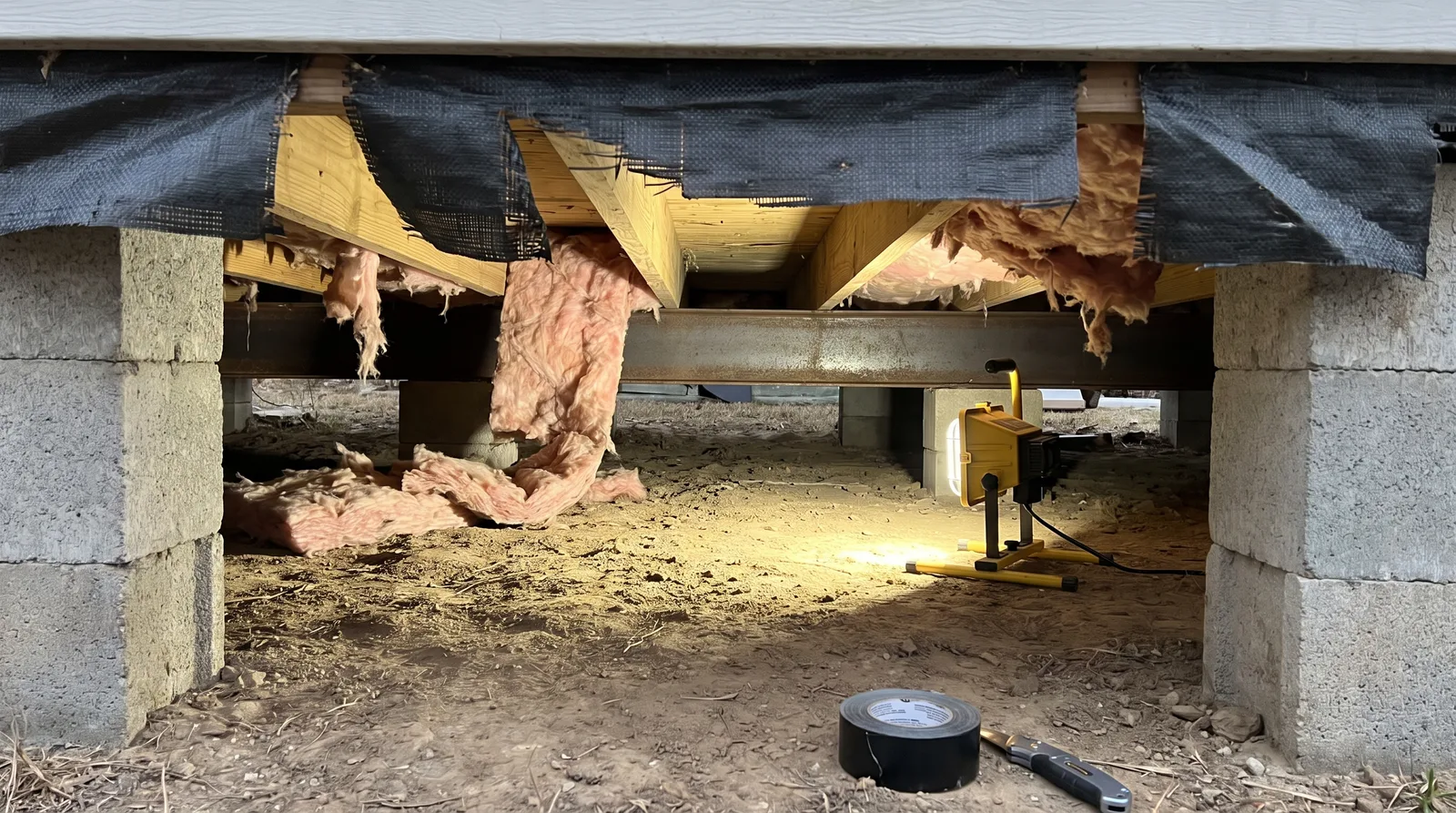
A torn bottom board is one of the cheapest repairs on a used mobile home and one of the most expensive to ignore. A 4-inch by 108-foot roll of belly repair tape is $34.95 and a full 16 x 80 replacement roll is $169.95, against $2,000 to $6,000 for a contractor to replace the underbelly. The tear itself is rarely the problem you are buying. What put the tear there usually is.
Every retail buyer who is serious about a home eventually gets on their knees and looks underneath it. What they see is black fabric. If that fabric is hanging in strips with insulation spilling out of it, you lost the sale before they stood back up, and new flooring inside does not get it back. Here is what the thing is, how to inspect it before you buy, and where the line sits between a $35 roll of tape and a four-figure contractor bill.
What the Underbelly Actually Is
A sheet of material stretched across the bottom of the floor framing, under the insulation and above the steel chassis, running the full length and width of the home. Not structural. It is a container: it holds the floor insulation up where it belongs and keeps everything else out.
The naming is a genuine mess, because suppliers, inspectors and code do not agree. Federal regulation calls it the bottom board and titles the repair section "Bottom board repair". Contractors say underbelly or belly wrap. Older trade usage runs to belly board, belly paper and black board. Suppliers sell the identical roll as "bottom board material," "belly wrap" and "vapor barrier belly bottom board" on three different pages. One contractor's write-up: the black material enclosing the base of a mobile home "is known by several names: bottom board, belly board or paper, black board, etc." Same part. If the seller says the belly paper is fine and the listing says the bottom board needs work, nobody is lying to you.
Material varies by era and builder. The same source lists what you will find: "asphalt-impregnated fiberboard or fiberglass, cloth or heavy tar paper, and woven polyethylene." The asphalt and tar-paper versions go brittle and crumble at the fastener line. What is sold today is woven poly, described by its supplier as "a special bottom closure woven from black tapes of high density polyethylene and extrusion coated with a continuous layer of black low density polyethylene." That is why repair tape sticks to a modern belly and peels off a 1978 one.
The underbelly is not the skirting. Skirting is the vertical material around the perimeter, defined in 24 CFR 3285.5 as enclosing the perimeter "from the bottom of the manufactured home to grade." The bottom board is horizontal, under the floor, behind the skirting. Different part, different repair, different cost. Crawlspace ventilation and the ground-cover math live in the skirting post and are not repeated here.
What the Code Says, and What It Does Not
Two federal rules touch this part, and they do different jobs.
Start with the construction standard, which sets the material spec. Bottom board material, with or without patches, must meet or exceed 48 inch-pounds of puncture resistance as tested by the Beach Puncture Test under ASTM D781-1968, and it "must be tight fitted against all penetrations" (24 CFR 3280.305(g)(6)). Patch material has to have an equivalent patch life to the board itself. That last clause is the one a roll of duct tape violates.
Its sibling, the installation standard, sets the repair method, and reads like a checklist because it is one. Under 24 CFR 3285.804:
- Inspect the covering for loosening or areas damaged or torn, and replace any missing insulation prior to closure.
- Splits or tears "must be resealed with tape or patches in accordance with methods provided in the manufacturers installation instructions."
- Plumbing P-traps "must be checked to be sure they are well-insulated and covered."
- "All edges of repaired areas must be taped or otherwise sealed."
Note the order. Insulation first, then close. Taping a sagging belly shut over wet, fallen fiberglass is not a repair, it is a lid.
One caveat matters to a buyer of used inventory: Part 3285 provides "minimum requirements for the initial installation of new manufactured homes," and states running approved installation programs substitute their own standards (24 CFR 3285.1). Nobody is citing you under 3285.804 for a torn belly on a 1994 single-wide. What the section gives you is the method every manufacturer's instructions are written against, and the standard a picky buyer's inspector compares your work to. Use it as the spec, not the threat.
Related: 24 CFR 3285.904 requires that insulation removed to reach a P-trap be replaced. Plumbers cut the belly open and a fair number never close it properly, so if the home has had under-floor plumbing work, look there first.
These requirements vary by state and change. Confirm the current rule with your state's manufactured housing program before relying on any of it for a permitted job.
What a Torn Belly Actually Costs You
The insulation stops working
Floor insulation is usually fiberglass batt sitting on the bottom board. Tear the board and it falls. One contractor's inspection of an aged underbelly found holes, rips, and "approximately 45% of the fiber insulation had fallen down and was resting on the ground." Batt that stays put stops working once it is wet: fiberglass insulates by trapping air, and "if it is wet or squashed, the air is gone, and the R-value drops to near zero." The same guide targets R-30 in the floor.
No heating-bill number here, because there is not a credible one. Every figure circulating for what a torn belly adds to a winter bill traces back to somebody's guess. The mechanism does not need a fake dollar sign on it: the insulation works only while something holds it against the joists.
Rodents get a door
The bottom board is the rodent barrier for the entire floor. Once it is open, the cavity is warm, dark and full of nesting material, which is exactly what a mouse is shopping for. A contractor who does this work full time says it directly: "Rodents and other animals are one of the biggest culprits here."
Gaps that look too small to bother with are not. CDC guidance is that "mice can fit through a hole the width of a pencil (1/4 inch or 6 millimeters in diameter)," and the same page tells homeowners to fix gaps in trailer skirting. What follows a rodent tenancy is not droppings, it is chewed wiring, chewed ductwork, and insulation that "should be removed, bagged, and discarded as construction waste" rather than reused.
The plumbing loses its blanket
Supply lines, drain lines and P-traps run in that cavity, and the bottom board plus the insulation is the entire freeze package for most of them. An open belly in a freeze-thaw market is a burst-pipe clock. A burst supply line under the floor does not stay a plumbing problem either. It becomes a subfloor problem, which the flipping guide flags as the single most value-destructive issue in this business.
Inspecting It Before You Buy
Do this on the first walkthrough, not after you own it. Bring a headlamp and knee pads.
A belly full of water is a different deal entirely from a belly with a tear in it. A tear is a $35 to $170 repair you do yourself. Standing water means an active leak above it, soaked insulation that has to be pulled and thrown away, and a real chance the subfloor is already soft. The flipping guide puts subfloor water-damage repair at $1,500 to $3,000, the entire repair budget on a typical single-wide flip. Price the water, not the fabric.
Materials, Roll Sizes and Real Prices
It is sold in two shapes. Full rolls are as wide as the home, sized to replace an entire underbelly in one piece. Repair rolls and tapes are narrow and meant for patching. Both are the same woven polyethylene, so a patch and a replacement are the same material and the same skill.
| Product | Size | Price |
|---|---|---|
| Bottom board repair tape, 2 in | 2 in wide | $31.95 |
| Bottom board repair tape, 4 in | 4 in x 108 ft | $34.95 |
| Under belly patch | 6 in x 108 ft | $49.95 |
| Belly bottomboard fabric, non-adhesive | 30 in x 100 ft | $42.99 |
| Bottom board repair roll, non-adhesive | 28 in x 100 ft | $44.95 |
| Bottom board repair roll, adhesive backed | 28 in x 25 ft | $59.95 |
| Full roll, 14-wide home | 14 ft x 70 ft | $139.95 |
| Full roll, 16-wide home | 16 ft x 80 ft | $169.95 |
| High-strength spray adhesive | aerosol can | $16.95 |
Prices from Star Supply USA and MH Parts, read September 2026.
Two things fall out of that table. First, the 30-inch by 100-foot roll at $42.99 is the most useful item on it for a flipper: wide enough to bridge a joist bay, long enough to cover every tear on a typical home, and cheaper than one adhesive-backed 25-foot roll. That plus a 4-inch tape covers almost everything short of a teardown, for under eighty dollars. Second, a whole-home replacement roll is $169.95. Memorize that one, because it is why most quoted replacement prices are labor.
On where to buy: this is not a big-box item and your local hardware store will not have it. It comes from manufactured-housing parts specialists, plus a few general retailers carrying the same Flex-Mend line. Order roll width to match the home's width, not the section width, and search "bottom board," "belly wrap" and "underbelly" before you decide a supplier is out of stock.
Patch or Replace, and Where the Line Is
Patching is cheaper, faster and completely legitimate. A contractor doing this full time draws the line at material condition rather than tear count: "Small, isolated tears in otherwise sound material can be patched with proper repair tape and backing," and replacement takes over when the material is brittle, sagging in multiple areas, or failed across a large section. A blunter rule of thumb from another guide: "If more than 25% of the belly wrap is compromised, it is time for a full replacement."
Two conditions force replacement regardless of torn area: brittle material, because tape will not bond to it and every patch tears a new hole around itself, and contaminated insulation, because wet, moldy or rodent-infested batt has to come out and be bagged, which means opening the belly anyway.
The patch method is short: cut the poly oversized, clean the surface, get insulation back up with kraft backing, then tape every edge. Heat speeds the bond. Full replacement means stapling new sheeting to the underside of the joists and cutting carefully around every pipe and duct. The trick that stops a new belly repeating the old one's failure is mechanical: run wood lath tacked across joist bottoms on 24-inch centers, so the fabric is not carrying the insulation alone.
Then there is the price of not doing it yourself. One underbelly repair specialist prices patching small tears at $150 to $300 and a full replacement at $2,000 to $6,000 (Mobile Home Under Belly Repairs). A second guide puts professional belly wrap and insulation repair at $800 to $1,500 against $150 to $300 doing it yourself. Put the $2,000 low end next to the $169.95 roll and the arithmetic is not subtle: the contractor is not charging you for fabric, they are charging for the hours somebody spends flat on their back in the dirt with a staple gun.
Put the belly number in the repair line and see what it does to your annualized return before you make the offer.
Open the free calculatorDoes It Pay on a Flip
Run it against the illustrative deal in the flipping guide: $5,500 purchase plus a $1,500 repair budget, $7,000 all-in, resold at $12,500, roughly 28.2% annualized. That $1,500 is the whole budget, and roof, subfloor and HVAC have first claim on it.
- Tape and patch, done yourself. A 4-inch tape at $34.95 is 2.3% of the repair budget. This is not a decision. Do it on every home you buy, tear or no tear, because you are already under there checking.
- Full DIY replacement. A $169.95 roll plus insulation and a weekend is about 11% of the budget. Still comfortably worth it where the belly is shot but the floor above it is sound.
- Contractor full replacement. At $2,000 the job exceeds your entire repair budget by $500. Stack it on the other repairs and all-in goes from $7,000 to $9,000 against the same $12,500 resale, cutting the spread from $5,500 to $3,500 before you touch the interest side of the deal.
So the honest answer is not "underbelly repair always pays." The DIY version always pays; the contracted version usually does not, on a single-wide at this price point. If you will not get under the home yourself, this repair comes off the seller's price before you buy, not out of your margin after.
Last, the part nobody prices. A taut, intact belly costs $35 and tells a retail buyer the home was maintained. A shredded one tells them the opposite about everything they cannot see, and invites the question you least want asked, which is what else is wrong under here. That is not an adjustment you will find in any book value. It shows up as the buyer who does not call back.
Common Questions
All of these: bottom board, belly wrap, belly board, belly paper, black board, underbelly, moisture barrier. Federal regulation uses "bottom board" and suppliers mostly sell it as "bottom board material" or "belly wrap." One part, too many names, so search all of them before deciding a supplier does not carry it.
Yes, that is the prescribed method. HUD's installation standard says splits or tears must be resealed with tape or patches per the manufacturer's instructions, with all edges taped or otherwise sealed. Use bottom board repair tape, not duct tape: the construction standard requires patch material to have an equivalent patch life to the board. Push fallen insulation back up first.
Manufactured-housing parts suppliers, mostly online. Full rolls are sized to the home: 14 ft x 70 ft is $139.95, 16 ft x 80 ft is $169.95. For repairs, a 30 in x 100 ft non-adhesive roll is $42.99 and 4-inch repair tape is $34.95. Hardware stores rarely stock it in the right width.
Usually not. A sag means weight, normally water from a leaking supply or drain line above, or insulation that soaked through and dropped. Poke it gently and see what comes out: clear and odorless is a supply line, grey or smelly is a drain. Replacing the fabric without finding the leak just gives the water a fresh bag to fill.