
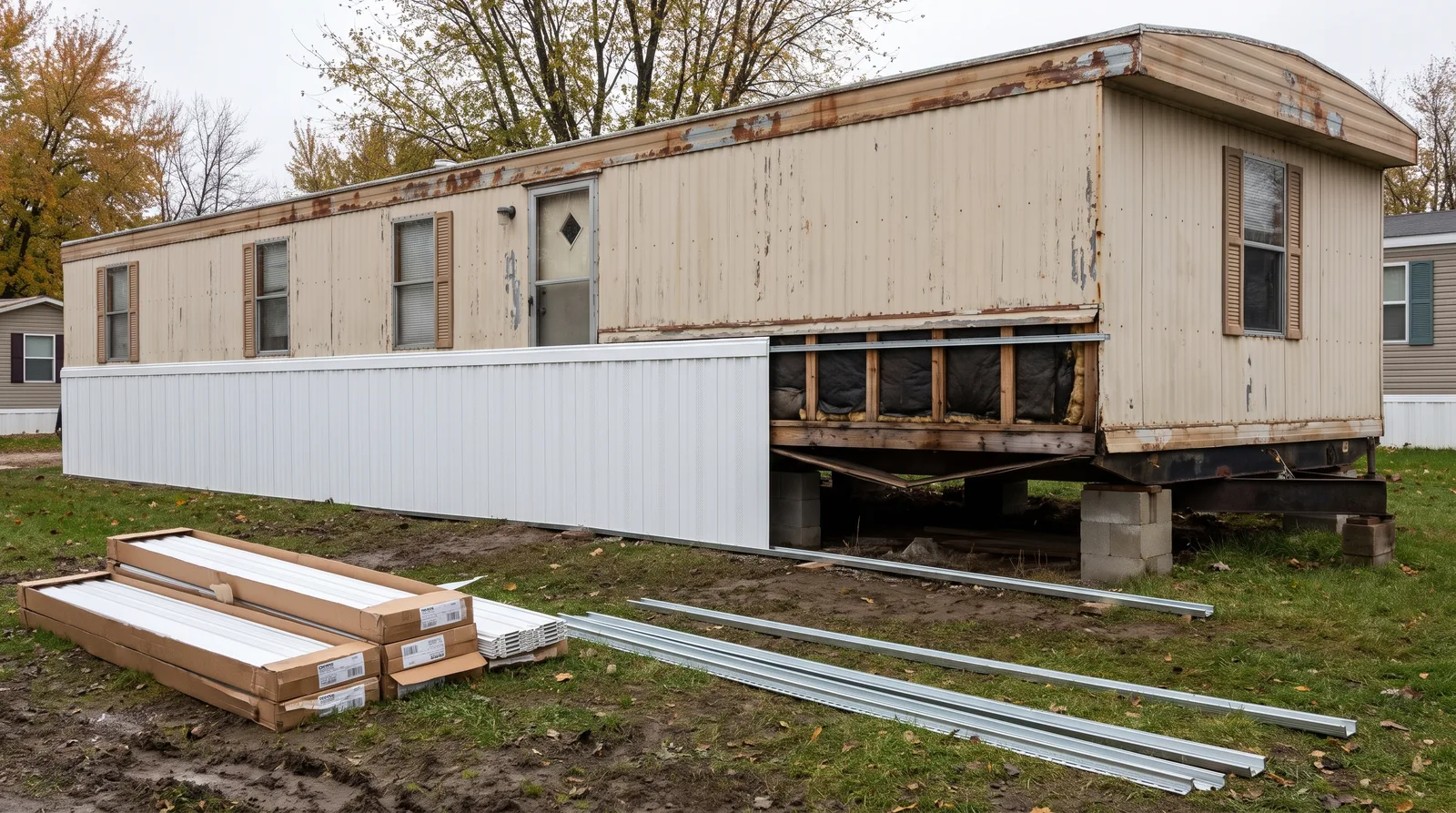
Vinyl skirting is the cheapest exterior fix on a cheap unit. A complete kit for a 16 x 70 single-wide runs $937.95 in material; a reported professionally installed 16 x 80 job came in at $2,356. Buy the kit, not the pieces: identical parts a la carte cost $717 more. And roll 6-mil poly across the dirt before you order vents, because a ground cover cuts the code-required ventilation area tenfold.
Skirting is the repair flippers argue about most. The flip guide calls it a gray zone, and that is fair: a rough skirt on a sound home is a price conversation, not a deal killer. But it is also the one repair a park manager can hold your sale hostage over. Here is what it costs, how the kits are actually sold, and the ventilation rule almost every article on this topic gets wrong.
What Skirting Is Actually Doing Down There
Four jobs, and only one of them is looks.
Moisture control
If the space under the home is going to be enclosed with skirting, a vapor retarder has to go down on the ground first: minimum six-mil polyethylene or equivalent, joints overlapped at least 12 inches, tears patched. The only exception is an arid region with dry soil (24 CFR 3285.204). Washington drops even that exception, requiring a vapor retarder under all manufactured homes (WAC 296-150I-0310).
Enclose a crawlspace without a ground cover and you have built a humidity chamber under a wood subfloor. Subfloor rot is the most value-destructive problem in this business, and this is one of the ways people cause it.
Freeze protection, but not the way people think
Skirting cuts wind off the underbelly, which helps. It is not a pipe insulation plan. HUD requires exposed supply piping, shutoff valves, pressure reducers and water heater compartment pipes to be insulated or otherwise protected from freezing, and permits only listed and certified heat tape (24 CFR 3285.603). Skirt a home in a cold market and call that your freeze plan and you do not have one.
Animals and wind
Vent openings have to be covered full height and width with a perforated, corrosion and weather resistant covering designed to prevent the entry of rodents (24 CFR 3285.505). Washington puts a number on it: mesh openings no larger than 1/4 inch. Gaps and broken panels let in moisture, pests and wind, which is how a skirting problem becomes a ductwork problem.
Dryer vents and combustion air inlets have to pass through the skirting to the outside, and appliance surface water has to be directed away from under the home. Both are in 3285.505. Wrapping a solid skirt around a dryer vent creates a lint-packed cavity nobody looks at again for years.
Who Actually Requires It
HUD does not. Its standard opens with "Skirting, if used," then regulates the material: weather-resistant, no trapping water between siding and trim, wood within six inches of grade pressure-treated to AWPA U1 Use Category 4A (24 CFR 3285.504). And before you go quoting HUD at a seller: Part 3285 governs the initial installation of new homes, and states running approved installation programs substitute their own standards (24 CFR 3285.1). On a used unit already in a park, the operative rule is state and local.
Which is where the requirement lives, and it has teeth:
- Washington. "A manufactured home must have a skirting around its entire perimeter." Not optional, not conditional (WAC 296-150I-0310).
- Virginia. Homes installed or relocated under the Building Code "shall have skirting installed within sixty days of occupancy," secured to resist wind and compensate for frost heave, with an access opening to the water and sewer connections at least 18 inches in any dimension and no less than three square feet (Va. Code 36-99.8, mirrored at VCC 427.4).
The second gate is the park, and it is contractual rather than statutory. Community rules become part of the lot lease your buyer signs, and management approval of that buyer is what closes your deal. Some parks specify masonry and exclude vinyl outright. Ask the manager in writing what the standard is before you buy the unit, not after you have ordered white vinyl (more in the park guide).
Code and park rules vary by state, county and community, and they change. Verify the current requirement with your building department and the manager before you order material.
The Ventilation Math Nobody Runs
This is the single most useful number on the page. For a crawlspace with skirting, the minimum net area of ventilation openings is one square foot for every 150 square feet of the home's floor area. That drops to one square foot for every 1,500 where six-mil poly or another acceptable vapor retarder covers the ground under the entire floor area (24 CFR 3285.505). Openings go as high above grade as practicable, on at least two opposite sides for cross-ventilation, with adjustable coverings in freezing climates.
Read that twice. The ground cover you were already required to install cuts your vent requirement by a factor of ten.
Run it on a 16 x 76 single-wide, 1,216 square feet of floor area:
| No ground cover | With 6-mil poly | |
|---|---|---|
| Ratio | 1,216 ÷ 150 | 1,216 ÷ 1,500 |
| Net free area required | 8.11 sq ft = 1,167 sq in | 0.81 sq ft = 117 sq in |
| Vents at 68 sq in each | 18 | 2 (use 4, two per side) |
| Vent cost at $34.99 each | $629.82 | $139.96 |
The 68 square inches is the net free area of a standard 8 x 16 automatic foundation vent, which opens at 75F, closes at 35F, and sells for $34.99. One 20 x 100 roll of six-mil poly covers that 1,216 square foot footprint with room for the required 12-inch laps, and you are required to lay it anyway. Skipping it does not save money. It costs you roughly $490 in extra vents and buys a wet crawlspace.
Kits do not ship a code-calculated vent count. One vendor package for a 16 x 70 includes eight vents: plenty for a poly-covered crawlspace, about half of what the 1:150 ratio demands without one. The kit is not doing your math.
How Vinyl Skirting Is Actually Sold
Five parts, and once you know them the ordering stops being confusing.
- Panels. Run vertically. Sold as 12-foot, actually 11 feet 8 inches long by 16 inches wide, .037 to .040 inch thick. You cut every one to height on site, which is why kits ship them uncut.
- Top back rail. Screws to the home under the siding. Carries the load.
- Top front rail. Snaps into the back rail, sandwiches the panel tops, hides the fasteners.
- Ground track. Staked into the dirt. Holds the panel bottoms and lets them float.
- Vents and an access door. Discrete foundation vents, or factory vented panels mixed into the run.
All three rails come in nominal 12-foot sticks, about 11 feet 7 inches of real length (buyer's guide, kit spec sheet). The lot is never level, so measure height at all four corners and the midpoint of all four sides, then work from the average.
Worked Example: A 16 x 76 Single-Wide
Illustrative, not a real job, but the arithmetic is the arithmetic. Assume a 16 x 76 with a 28-inch average skirt height.
Sanity check the method against a real kit. A published 16 x 70 package at 28 inches ships 27 panels and 15 each of the three rails. Run the same formula on a 16 x 70 (172 feet, 129 pieces, 5 cuts per panel) and you get 26 panels and 15 rails per run. Rails match exactly; the panel count is one under, which is what a vendor's spare looks like.
What It Costs
Bought as a complete package, a 16 x 70 vinyl kit with 27 panels, 45 rails, 100 ground spikes and 200 screws is $937.95 at a 28-inch average height, or about $5.45 per linear foot. The same home at 48 inches is $1,278.95. Full-house packages elsewhere run $1,389.99 to $1,689.99 for single-wides.
Now buy those same parts one at a time, at $27.99 per panel and $19.99 per rail: 27 panels is $755.73, 45 rails is $899.55, total $1,655.28. That is $717 more for an identical bill of materials, a 1.8x markup for ordering piecemeal. Buy the kit. Buy loose pieces only for repairs.
For installed work the honest anchor is a reported job: a 16 x 80 at $2,356, being $1,456 material and $900 labor. Ranges around that: vinyl material $3 to $8 per linear foot, labor adding $6 to $12, single-wide DIY material $630 to $1,090 against $1,000 to $2,500 installed. On 184 feet, labor alone is $1,100 to $2,200, more than the material.
That gap is the whole argument for doing it yourself. Skirting is not skilled work. It is measuring, a chalk line, tin snips and stakes.
Add the skirting to your repair budget and see what it does to your annualized return before you order anything.
Open the free calculatorThe Alternatives, Honestly
| Material | Single-wide cost | The tradeoff |
|---|---|---|
| Vinyl | $630 to $1,090 material, $1,000 to $2,500 installed | Cheapest and easiest, and it cracks. Panels slide out and back in without tools. |
| Metal | $30.54 per 28 x 60 galvanized panel, $5 to $15 per linear foot | $6.11 per foot before trim, so no real savings. Dents, and cut edges rust. |
| Faux rock or brick (ABS) | 16 x 70 rock package $2,200.95; brick $1,000 to $2,400; $1,500 to $4,000 installed | Best curb appeal by a distance, at 2.3x the vinyl kit. Panels 5 feet wide, 30 to 48 inches tall. |
| Insulated vinyl | $1,440 to $2,500+ material, $2,000 to $4,500 installed | Hard to recover on a flip unless the buyer is paying the heat bill and you can prove it. |
| Concrete block / cement board | $700 to $1,000 material, $2,000 to $4,000+ installed | Permanent and mower-proof. Slowest install, and often the only thing masonry-only parks accept. |
Figures: Mobile Home Friend, CostHelper, Mobile Home Parts Depot, American Supply.
The comparison that matters: the same 16 x 70 is $937.95 in vinyl and $2,200.95 in faux rock. That $1,263 is real money against a unit reselling in the low five figures, and it does not raise your resale price by $1,263. Spend it on what actually moves a valuation.
Install and Repair: What Breaks First
The bottom edge, and it is not close. A weed trimmer shreds vinyl at ground level, a mower cracks it with a thrown rock, and after a decade in UV the panels get brittle enough that flying debris alone chips them. Three things cut that down:
- Leave the panels loose in the track. Vinyl expands and contracts substantially with temperature. Snug them up in July and you find them buckled or split in January.
- Give the trimmer something else to hit. A gravel or paver strip along the base takes the abuse instead of the panel. Cheap insurance on a $940 skirt.
- Stake the ground track and expect frost heave. Virginia's code names it directly, requiring skirting be secured to compensate for possible frost heave. In a freeze-thaw market the track lifts, panels ride up, and the top edge pops out of the front rail. To a buyer that reads as bad workmanship.
Repairs are easy while the profile is still made: cracked panels slide out and new ones slide in, usually without tools. The catch, per Mobile Homes and Beyond, is that discontinued profiles are the most common reason a small repair turns into replacing a whole side. Match the profile, not just the color.
Before you close the skirt, put the access opening where the water and sewer connections are: at least 18 by 24 inches and no less than three square feet. Virginia allows 18 inches in any dimension and bars access panels needing special tools. Sealing a crawlspace with no way in is a repeat mistake.
Should You Even Do It on This Flip
Start by finding out whether you have a choice. If the state requires it, a local ordinance puts a clock on it, or the park's rules name a material, this is not a cost-benefit exercise. It is a condition of closing, and the number goes in the repair budget before you make the offer.
If it is genuinely optional, use the flip guide's ordering: on a home with a sound roof, dry subfloor and working HVAC, paint, flooring and a deep clean are the highest return per dollar available. Skirting is not in that tier. In the illustrative deal in the flip guide, the whole repair budget is $1,500 against a $12,500 resale. A full skirt at roughly $1,000 in kit material eats two thirds of it.
- Missing, or missing whole sections. Do it. Bare piers read as abandoned, and an open crawlspace is an underbelly and ductwork risk you inherit.
- Intact but cracked, mismatched or filthy. Replace individual panels, pressure wash, reprice. Two hundred dollars and an afternoon.
- Intact but you just do not like it. Leave it. Nobody has ever paid a premium for nicer white vinyl.
Whatever you decide, put the number in the repair line before you offer, not after. Run it through the free Deal Calculator and see what a $1,000 skirt does to your annualized return. Sometimes it barely registers. Sometimes it is the difference between a deal and a lesson.
Common Questions
Perimeter in inches divided by 16 gives finished pieces. Divide 140 by your average height and round down for pieces per stock panel. A 16 x 76 at 28 inches is 138 pieces, 5 per panel, so 28 panels plus 16 sticks each of top back rail, top front rail and ground track.
One square foot of net free area per 150 square feet of floor area, dropping to one per 1,500 with six-mil poly on the ground. On a 1,216 square foot single-wide with a ground cover that is about 117 square inches, or two of the common 68-square-inch vents. Use four so you get cross-ventilation on opposite sides, and confirm your state's number.
Substantially. The parts in a $937.95 16 x 70 kit cost $1,655.28 bought individually. Buy the kit, and keep a few loose panels for repairs.
No. It blocks wind, which helps, but HUD requires exposed supply piping, valves and water heater compartment pipes to be insulated or otherwise protected, with listed and certified heat tape only. Skirting is not a substitute.