
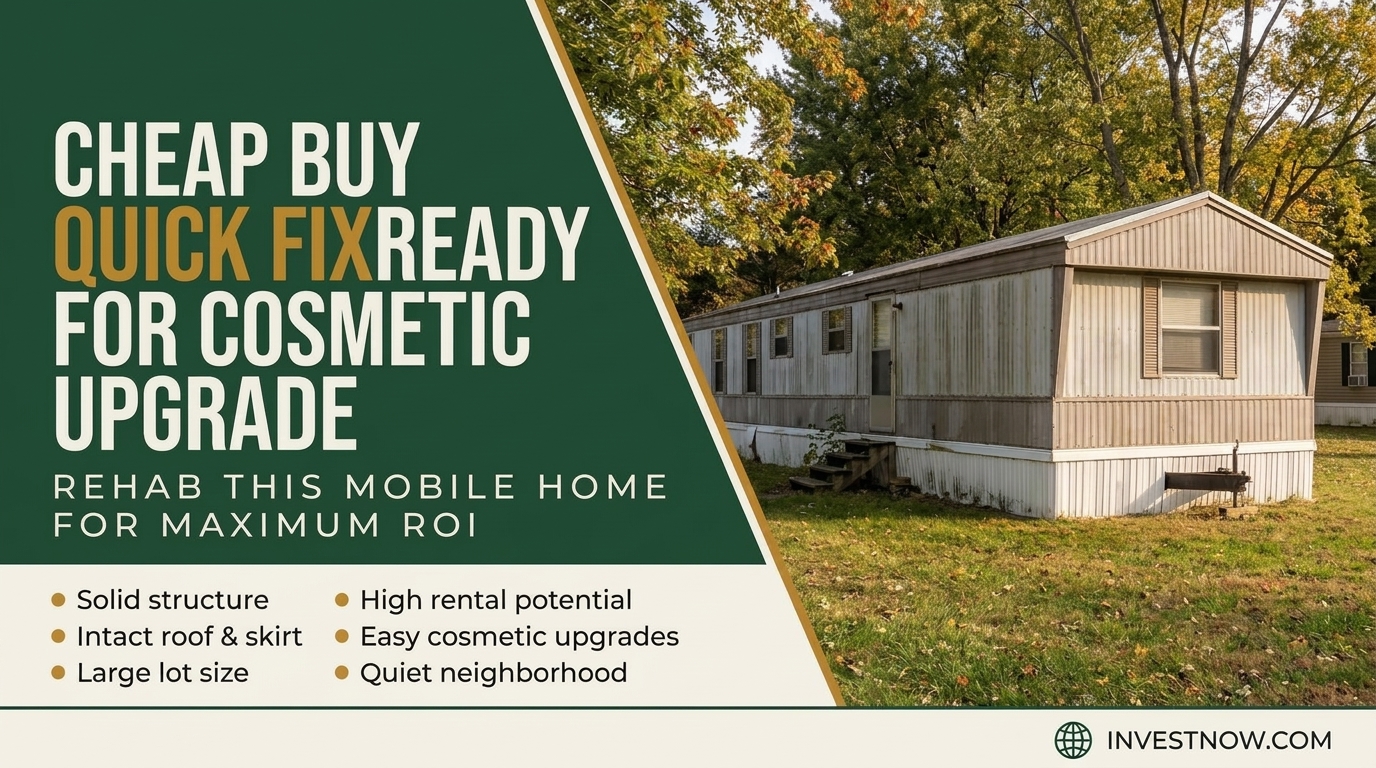
A used mobile home bought for $8,000, repaired for $3,000, and sold on owner financing for $22,000 at 12.9% interest does not behave like a stock or a rental. It pays you a markup at closing, then it pays you again every month for years. That two-stream structure is the reason mobile home investors talk about returns that look absurd on paper until you actually work through the arithmetic.
A typical used mobile home deal bought at $8,000, repaired for $3,000, and sold with owner financing at $22,000 can return the full capital outlay within 18 months and generate thousands more in note payments over the remaining term.
The Math Behind Two Revenue Streams
Most investments pay you one way. Owner-financed mobile homes pay you twice, and the structure is straightforward once you map it out.
Stream one is the markup. You buy at $8,000, spend $3,000 on repairs, and carry $11,000 in total cost. You sell at $22,000. That is an $11,000 gross spread before any financing income. If the buyer puts $3,500 down, you collect roughly $7,500 of that spread immediately and carry a note on the remaining $18,500.
Stream two is the note. At 12.9% interest on an $18,500 balance over 60 months, the monthly payment lands around $419. Over the life of the note that is $25,140 in total payments on a balance of $18,500 - meaning you collect roughly $6,640 in interest on top of principal. Add the $3,500 down payment and the $11,000 gross spread and the full return from a single deal clears $20,000 on an $11,000 outlay. That is the range a worked calculator confirms on deals structured this way.
What 28% Annual Return Actually Looks Like
Percentages float. Dollar amounts anchor. On the deal above, $11,000 invested returns roughly $20,000 across the full note term. Spread over five years, that is a compounded annual return in the high 20s. But the more useful number for most investors is the payback period.
The $3,500 down payment covers one-third of your total outlay on day one. Monthly payments of $419 cover the remaining $7,500 in about 18 months. From month 19 onward, every payment is profit. That timeline matters more than the annualized percentage for anyone recycling capital into a second deal.
Why the Repair Budget Matters More Than Purchase Price
Buying cheap is not enough on its own. The number that actually determines your margin is total cost in, which means purchase price plus every dollar of repair. A home bought for $5,000 with $9,000 in hidden repair needs costs you $14,000 and compresses your spread on a $22,000 sale down to $8,000 gross. That same $22,000 sale on an $11,000 all-in cost delivers $11,000 gross. The $6,000 difference comes entirely from what you did or did not know about the repair budget before you signed.
Before closing on any unit, walk the roof, the belly wrap, the plumbing under the home, and the electrical panel. Get a rough material estimate for anything that needs work. Cosmetic repairs, new flooring, paint, and light fixtures, tend to run predictably. Structural items like floor joists, roof decking, or HVAC replacement are where budgets blow out. Factor the worst-case repair number into your calculator before you make an offer, not after.
The Down Payment as a Deal Structure Lever
The down payment does several things at once. It reduces your note balance, which reduces the buyer's monthly payment, which widens your pool of qualifying buyers. It also accelerates your own capital recovery. A $3,500 down payment on an $18,500 note recovers about 32% of your total outlay on day one. Raise that to $5,000 and you recover 45% immediately, but you may cut out buyers who cannot scrape together that much upfront.
The practical range for used mobile homes in most markets runs between $1,500 and $5,000 down. Below $1,500, buyer default risk climbs because the buyer has little equity and little to lose. Above $5,000 on a modest home, you may be pricing out the buyers most attracted to owner financing in the first place. The calculator shows how each increment affects monthly payment, total interest collected, and payback timeline so you can find the number that works for your market.
Owner Financing Has Legal Boundaries You Need to Know
Most states cap the interest rate a private seller can charge on owner-financed real estate. Some set the limit at 10%, others allow higher rates on personal property, which is how most used mobile homes are titled. The distinction between real property and personal property (chattel) changes which rules apply, and the rules vary by state.
Federal law adds another layer. The Dodd-Frank Act and the SAFE Act both touch owner financing, and the number of homes you sell per year determines whether you fall under their licensing requirements. Selling one home a year to an occupant buyer sits in a different regulatory category than selling a dozen. None of this is designed to scare investors off the model. It is designed to keep you operating legally, which protects the note you are holding.
The Trailer Trash Cash toolkit covers usury caps, Dodd-Frank thresholds, and SAFE Act triggers in detail. It also includes contract templates drafted with these limits in mind. Compliant paperwork is not optional. A note that violates state usury law can be voided, which means you lose the payment stream you structured the whole deal around.
Run the Numbers Before You Spend a Dollar
The highest-risk moment in any mobile home deal is before you run the numbers, not after. Most bad deals look fine in your head and fall apart in a spreadsheet. The Trailer Trash Cash calculator exists specifically to force that reckoning before money changes hands.
Plug in a real home you are considering. Use your actual repair estimate, not a hopeful one. Use a conservative sale price based on what similar homes are selling for in your county, not the top of the range. If the calculator still shows a payback under 24 months and a gross return above $8,000, you probably have a deal worth pursuing. If the numbers look thin at conservative inputs, the deal is telling you something.
Seven Days to Decide If This Model Fits You
The full Trailer Trash Cash toolkit, which includes the book, the deal calculator, and the contract templates, runs $47. That is a number you can lose without regret if the model turns out not to suit you. It also comes with a 7-day refund policy, so the actual risk of testing it is close to zero.
Most people know within the first few hours of using the calculator whether this business model clicks for them. Either the math makes sense and the deal structures start feeling real, or it does not land that way and you ask for your $47 back. Seven days is enough time to run five or six hypothetical deals, read through the compliance section, and make a clear-headed decision.