
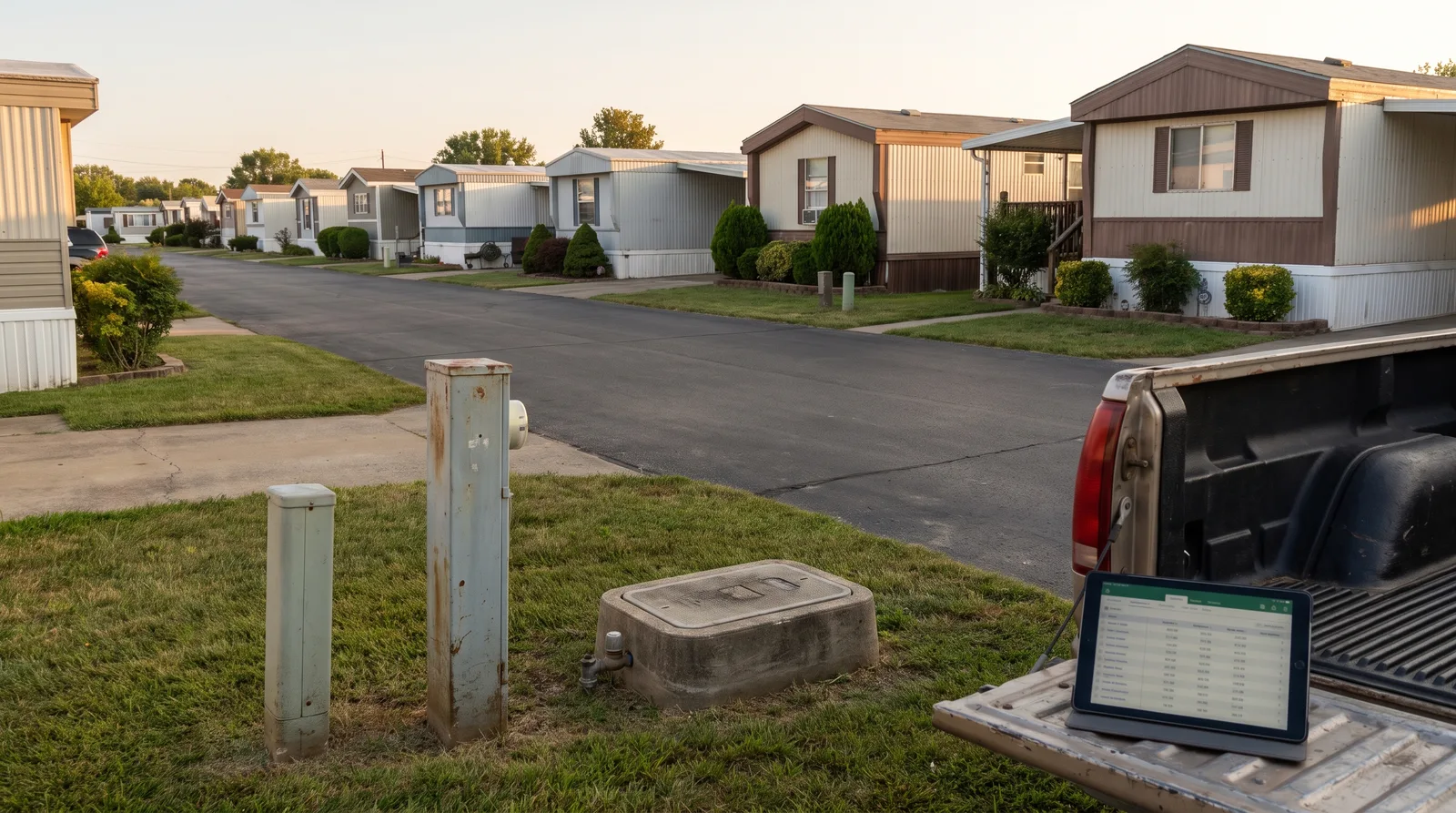
Pad count decides this, not the feature list. Under roughly 20 pads a spreadsheet plus a payment app is genuinely fine, and the serious platforms are absurd at that size: Yardi Breeze Premier carries a $400 per month minimum, which is $20 per pad on a 20-lot park. From about 20 to 150 pads you want a tool that splits lot rent from home rent and posts submetered utility charges to a resident ledger, and that is where manufactured-housing-specific software starts paying for itself. Above that, the real vendors are Rent Manager, ManageAmerica and Yardi, and every one of them is quote only.
This post assumes you already own a park or you are about to close on one. If you are still deciding whether to buy a park at all, that question is answered in the park investing guide, and the honest answer there is mostly "start smaller." What follows is the operations problem that shows up the week after you close.
Why Apartment Software Breaks in a Park
Every mainstream property management platform is built on one assumption that is false in a mobile home park: that you own the dwelling. Everything downstream of it bends, which is why "just use Buildium" is bad advice for any park with complexity.
One resident can owe you two different rents. A tenant in a park-owned home pays lot rent for the dirt and home rent for the structure. Those are separate revenue lines with separate expense profiles and, if you ever refinance, separate treatment by a lender. Rent Manager handles this by treating physical homes as assets you lease to residents "just like units," generating one lease for the unit and one for the home asset at the same time. Yardi MH Manager, which launched in December 2025 for institutional operators, tracks lots and homes as distinct assets. Lotly markets the same split as its headline feature. Apartment software has one object, the unit, and one rent.
Most of your residents own their own house. In a lot-rent-only community the resident holds title to the structure sitting on your land, and they can sell it to somebody you have never met. That means the software needs fields no apartment platform has. Yardi Breeze's manufactured housing module tracks "the manufacturer, make, model and title of homes and RVs," records changes in home ownership and lot rental, and follows the title process through a purchase or sale. If you have ever tried to reconstruct who actually owns unit 34 from a folder of scanned bills of sale, you understand why that field matters.
You are running a small utility company. Most parks buy water, and often sewer and sometimes electric, on a master meter and pass the cost through. That is a monthly billing operation with meter reads, rate calculations, and a charge that has to land on the right resident ledger before the rent is due. ManageAmerica, which calls itself "the only property management software built exclusively for manufactured housing," sells monthly utility rate recertification and month-over-month meter variance reporting as core product. Rent Manager has a Metered Utilities module and captures field meter reads through its rmAppSuite Pro mobile app.
Sell homes on notes and you are a lender too. If you sell park-owned homes on a note instead of renting them, you are servicing paper, not collecting rent. Yardi MH Manager names loan servicing as a feature for exactly this reason. If that model is new to you, start with the owner financing guide before you shop for software to run it.
The Only Question That Actually Sorts the Market
Most "best software" posts list ten vendors and refuse to say which one is for you. Here is the sorting rule they leave out.
Under about 20 pads, you are not a software buyer. You are a person with a rent roll. Skip to the spreadsheet section below.
20 to about 150 pads is where most independent park owners actually live. You have enough lots that manual utility billing eats a weekend a month, enough delinquency that you need dated records, and not enough scale to absorb an enterprise minimum. This tier gets served by cheap generalists that do not understand parks, and by a small number of manufactured-housing tools priced per lot.
Above roughly 150 pads, or across multiple communities, you are buying accounting depth, multi-entity reporting and a real implementation. That is Rent Manager, ManageAmerica and Yardi territory, and it comes with a sales call instead of a price tag.
What the Vendors Actually Publish
Everything below was read off the vendor's own site. Where a vendor publishes no number, the cell says quote only rather than a guess.
| Vendor | Who it fits | MH-specific features | Published pricing | Minimum |
|---|---|---|---|---|
| Innago | Smallest parks, no budget | Markets a mobile home page; no lot/home split or utility billing named | Free to the landlord. Tenants pay $2 per ACH payment or 2.99% by card; screening $30 to $35, charged to the applicant | None published |
| TenantCloud | Very small landlords | None. Mobile home parks are not mentioned | Starter $15/mo annual (10 leases), Growth $29.17/mo (30 leases), Pro $50/mo (60 leases), Business from $100/mo | Tiered by lease count |
| Lotly | Small to mid parks that want MH-native without a sales call | Lot rent and home rent split, utility billback with meter reads posted to the ledger, delinquency escalation, certified-mail notices, eviction checklists | $1.25 per occupied lot/mo (1 to 249 lots), $1.00 (250 to 999), $0.75 (1,000+). Vacant lots free. ACH $0.99/transaction, certified mail $9.99 to $15.00 per letter | None published |
| Buildium | General residential portfolios | None. Manufactured housing is not a listed property type | Essential from $62/mo, Growth from $192/mo, Premium from $400/mo | None stated; call above 5,000 units |
| DoorLoop | General residential portfolios | None. Mobile home parks are not a listed portfolio type | Starter $99/mo (10-unit cap), Pro $189/mo, Premium $239/mo, billed yearly. A 30% promo was showing at $69, $149 and $209 | 10 units on Starter; demo above 300 |
| Yardi Breeze Premier | Mid-size operators, especially mixed portfolios | Community-owned vs resident-owned homes and lots, manufacturer/make/model/title of homes and RVs, ownership change tracking, title process, optional utility billing add-on | Quote only for manufactured housing. For scale, residential Breeze is $1/unit/mo with a $100/mo minimum; Premier is $1/unit/mo with a $400/mo minimum | The $400/mo Premier minimum is the real floor |
| AppFolio | Larger general portfolios | None named. Manufactured housing is absent from the pricing page | Quote only. Core, Plus and Max tiers, no dollar figures | "Minimum spend and 50 unit minimum apply" on Core |
| Rent Manager | Larger or accounting-heavy operators, mixed asset types | Homes as leasable assets with a paired unit and home lease, Metered Utilities module, mobile meter reads via rmAppSuite Pro, make-ready boards | Quote only. The pricing page shows Basic, Plus and Premium with a feature grid and a "Get Quote" button, no dollar figures anywhere | Not published |
| ManageAmerica | MH-only operators, mid-market and up | Built exclusively for manufactured housing: community tracking, utility management with rate recertification and meter variance reporting, billing and collections, resident portal | Quote only. Core, Signature and Premier tiers; the site says pricing is tailored to portfolio size and that it charges per property | Not disclosed |
| Yardi MH Manager | Institutional operators only | Lots and homes as distinct assets, violation management, rent collection, loan servicing, resident portal, built on Yardi Voyager | Quote only | Aimed at large-scale operators; launched December 2025 |
Rent Manager used to publish per-unit rates and no longer does. Any per-unit number you find for it in a comparison post is somebody's memory of an old page, not a current quote. Software pricing in this category changes without announcement, so treat every figure above as of the day it was read and confirm it on the demo.
The Spreadsheet Floor
Nobody selling software will tell you this, so here it is. Under about 20 occupied pads, a spreadsheet and a payment app do the job, and the arithmetic is not close.
Run the numbers on a 20-lot park. Yardi Breeze Premier's $400 monthly minimum works out to $20 per pad per month. If your lot rent is $350, you are handing over 5.7% of gross scheduled rent to software before you pay taxes, insurance, or the water bill. Nothing in that product returns 5.7% of gross on a 20-lot property.
What a spreadsheet handles fine at that size: one row per lot, tenant name, lease dates, monthly lot rent, monthly home rent if any, and a paid column per month. Add a shared cloud folder of scanned leases, titles and bills of sale, plus a payment app so you are not collecting money orders in person. That is a complete system for a small park, and it costs nothing.
Two things break it, and they break it hard.
Submetered utility billing. The moment you are reading a meter at each lot, applying a rate, and posting a per-resident charge every month, a spreadsheet becomes a monthly data-entry job with no audit trail. Twenty lots times twelve months is 240 hand-calculated charges a year, each of which a resident can dispute and you cannot prove.
Delinquency and notices. Delinquency is not a balance, it is a timeline: when rent came due, when the notice went out, when the cure period expired, and what proof you hold of each. That is exactly the record a court asks for and exactly the record a spreadsheet does not create. Lotly sells certified-mail integration and cure-deadline tracking precisely because this is where small operators get hurt.
The trigger for buying software is not lot count on its own. It is the first month you bill submetered utilities, or the first eviction you have to document. Either one can happen at 12 pads, and then you are a software buyer regardless of size.
Submetering Changes the Economics, and the Evidence Is Blunt
Most parks are master metered: the utility bills the park one number for the whole community, and the owner either eats it or passes it through. There are three ways to pass it through, and they do not perform the same.
- In rent. Water is baked into lot rent. The resident has no reason to care about a running toilet, because it costs them nothing.
- RUBS, or ratio utility billing. You split the master bill by a formula such as occupant count, bedrooms or square footage. No meters required, so it is cheap to start.
- Submetering. A meter on each lot, and each resident is billed for actual consumption.
The difference between those is measurable. A 2004 study by Aquacraft, funded by the EPA, two national apartment associations and ten water utilities, found submetered properties used 15.3% less water than properties that billed water in rent, roughly 8,000 gallons per unit per year. The same study found no water savings at all from allocated billing programs. A California legislative analysis citing the study puts it plainly: "A 2004 Aquacraft Inc. study showed water savings of 15.3% when comparing sub-metered properties with rental properties that do not bill water separately from rent."
That study was run on apartments, not parks, and it is old. But the mechanism does not care what kind of building you own: people conserve when the meter is theirs, and they do not when the bill is a formula. If you are master metered and absorbing water, submetering is the change with the clearest evidence behind it, and it is a real capital expense. Run it as its own line item, not a footnote.
The billing method is also a legal question, not just an operational one, and it varies by state. Minnesota is a useful example of how sharp the rules can get: under Minn. Stat. 327C.04, a park owner who charges residents for a utility service "must charge each household the same amount, unless the park owner has installed measuring devices." In a state with that rule, a ratio formula is not one of your options. Your choices are meters or an equal split, and software that only knows how to do RUBS is useless to you there. Utility billing law for manufactured home communities is state specific and changes; confirm your own state's rule with a local attorney before you set a billing method.
What the software contributes is the loop between the meter and the ledger: capturing reads in the field, applying the current rate, posting the charge to the right resident, and flagging reads that moved when they should not have. ManageAmerica's month-over-month meter variance reporting is a leak detector wearing a reporting label. Rent Manager pushes reads through its mobile app. Lotly posts billback charges straight onto the ledger. Any of those beats a clipboard and a calculator.
Run a real deal and see what the operating line can actually absorb.
Open the free calculatorOnline Rent Payment: Plan for a Paper Minority
Every vendor sells the resident portal as the headline. Before you build a plan around it, know what is actually published and what is not.
There is no published survey of online payment adoption in manufactured housing communities. Not one. Every adoption number in circulation comes from the apartment sector. The most current figure a vendor cites is from the 2024 NMHC and Grace Hill Renter Preferences Survey, which Yardi reports as 97% of renters preferring online payments. Read that carefully: it is apartment renters, it is a preference, and it is a software vendor citing it. It is not evidence that 97% of your park will enroll.
Expect lower adoption in a park than in an apartment building, for a structural reason. The FDIC's 2023 household survey found 4.2% of US households, about 5.6 million, had no bank or credit union account at all, and the FDIC reports that unbanked rates "remain higher among lower-income households" and among households whose income varies a lot month to month. That describes a meaningful share of park residents. A resident without an account cannot ACH you no matter how good your portal is.
The other adoption killer is one you control. Innago charges the tenant $2 per ACH payment or 2.99% on a card. On $350 lot rent, the card route costs a resident $10.47 to hand you money they already owe. Pass that through and some share of your residents will write checks forever, rationally. Absorb the ACH fee.
Plan on this instead. Your portal will carry most of the rent roll, a stubborn minority will pay by check or money order indefinitely, and any vendor who tells you they will get you to 100% is selling.
What to Ask on the Demo
Common Questions
You can collect lot rent with them, and plenty of small owners do. Neither lists manufactured housing as a supported property type on its pricing page, so you get a unit-and-rent model with no concept of a resident-owned home, no title tracking, and no purpose-built utility billback. Workable for a lot-rent-only park with utilities in rent. It falls apart the moment you own homes or submeter.
They price on portfolio size, module mix and implementation scope, and a published number invites comparison. Rent Manager, ManageAmerica, AppFolio and Yardi MH Manager all route you to a quote, and Rent Manager has removed the per-unit rates it once published. Expect an onboarding fee on top of the subscription and ask for it explicitly, because it usually is not volunteered.
When you start billing submetered utilities, or when you have to document a delinquency to a court. Both are record-keeping problems where a spreadsheet has no audit trail. Lot count is a weak proxy; the real trigger is the first month one of those two things is true.
The evidence for consumption dropping is strong. The 2004 EPA-funded Aquacraft study measured 15.3% lower water use in submetered properties versus water-in-rent properties, and found no measurable savings from ratio billing. Whether the meters pay back depends on your water rate, your lot count and your install cost, so price it as its own capital project. Also confirm your state's rules first, because some states restrict how you are allowed to bill.
No, and buying early is a good way to waste money on a deal that does not close. What you need before closing is the rent roll, the delinquency history and the utility bills, all of which arrive as a spreadsheet anyway. If you are still underwriting, the park investing guide and the valuation method for any park-owned homes are the better use of your time.