
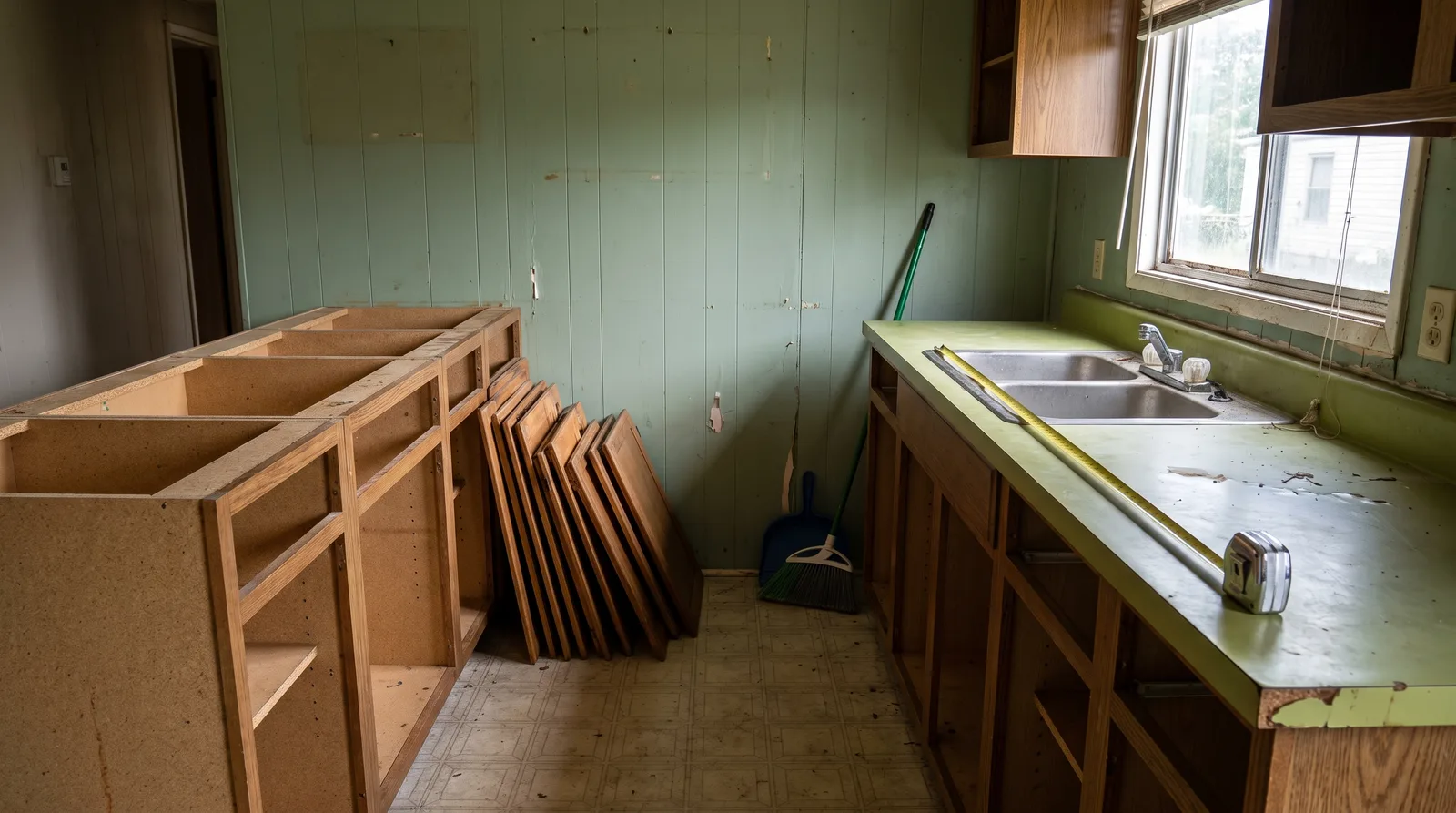
Cabinet work is quoted per linear foot and the options span a huge range: re-hardware for under $100 in parts, paint at $200 to $600 DIY or $30 to $70 per linear foot professionally, reface at $150 to $450 per linear foot, replace with stock or RTA boxes at $100 to $300 per linear foot installed. On a flip carrying a $1,500 repair budget, only the bottom of that list survives the math. And nothing on a big-box shelf was built to your home's dimensions, because your cabinets were built in place.
Almost everything written on this topic is aimed at somebody who lives in the home. Flipping asks a narrower question: what does the job cost, will the parts fit, and does the money come back at resale.
Why Nothing at the Big Box Store Fits
Site-built cabinetry is one of the most standardized products in construction. A base cabinet is 34.5 inches tall and 24 inches deep, in widths stepping in 3-inch increments from 9 to 42 inches, over a toe kick 3.5 inches tall and 3 inches deep. Add a 1.5-inch countertop and the finish height lands at 36 inches. Wall cabinets are 12 inches deep and come 30, 36 or 42 inches tall (cabinet dimensions, toe kick standards).
Your mobile home does not use a different standard. It uses no published standard at all. Original manufactured-home cabinets were built in place on the production line, not assembled from modules, and investors on the Mobile Home University forum put the consequence bluntly: the kitchen "probably is out of square, you will have gaps, especially if cabs and c-tops go to a wall corner." Pre-made boxes are square. Your walls are not. Three more things separate your kitchen from the display floor.
- The boxes are light on purpose. Most are particleboard or MDF with a vinyl or laminate skin, kept lightweight for transport weight limits. They were never built to carry a stone top or survive a soaking.
- The walls behind them are thin. Manufactured-home walls are often framed with 2x3 or even 1x2 studs instead of 2x4s, and while spacing is usually 16 or 24 inches, "sometimes they are random."
- The room is narrower. A standard 24-inch-deep base cabinet can block an aisle or doorway the original shallower run cleared fine.
Ceiling height compounds it. HUD's standard requires only 7 feet of ceiling over half a habitable room's floor area and 6 feet 4 inches under dropped ducts and beams (24 CFR 3280.104). Site-built kitchens are laid out against 8-foot walls, so a 42-inch wall cabinet will not automatically clear.
Price nothing until you have measured: base and wall cabinet depth and height, counter depth at three points, and the width of every opening the boxes must travel through. The suppliers who serve this market sell doors, hinges and drawer guides. None publish a box-dimension table, because there is not one to publish.
The Four Options, Priced
| Option | Cost | When it is right |
|---|---|---|
| Clean and re-hardware | Under $100 in parts | Boxes sound, kitchen looks tired |
| Paint, or swap doors only | $200 to $600 DIY; $30 to $70 per linear foot pro | Boxes sound, finish dated or peeling |
| Reface | $150 to $450 per linear foot | Almost never on a flip |
| Replace (stock or RTA) | $100 to $300 per linear foot installed | Boxes are wet, racked or coming apart |
1. Clean and re-hardware
Highest return per dollar in the kitchen, and it is not close. Degrease, tighten every screw, replace the parts that make a cabinet feel broken. Mobile-home suppliers price those individually: knobs at $1.93, self-close hinges at $3.30 to $4.95, a drawer rail guide at $0.95, a door friction catch at $1.22. Twenty knobs and a dozen hinges lands under $100, against $3 to $5 per knob and $15 to $40 per pair of hinges at general retail. A drawer that comes off the track in front of a buyer reads as "what else is broken."
2. Paint, or just swap the doors
Painting is where your labor pays. Pros charge $30 to $70 per linear foot brushed, $40 to $100 sprayed, or $70 to $125 per door, with labor at 80 to 85 percent of the bill and a typical kitchen at $2,000 to $6,500. Doing it yourself is $200 to $600 in materials. Respect the substrate: you are painting a vinyl wrap over particleboard, not bare oak, and prep is the entire job. Where the wrap has lifted near the oven, paint only makes the lifted edge a different color.
The middle path most flippers skip is buying replacement doors and keeping the boxes. Composite doors list at $7.61 to $24.53, wood doors at $15.03 to $23.95, so sixteen doors is $122 to $392 in parts, against $2,000 to $7,000 for the same job through a contractor at general retail.
3. Reface
New doors and drawer fronts plus veneer over the existing face frames, at $150 to $450 per linear foot, averaging $7,230 nationally. That is 30 to 50 percent cheaper than tearing everything out, a real saving on a site-built kitchen and almost never the answer here: the average refacing job costs more than the entire all-in cost of the home in the worked example in the flipping guide. Refacing also puts a new face on a box, and on a damp particleboard sink base the box is what failed.
4. Replace with stock or RTA boxes
Stock cabinets run $100 to $300 per linear foot installed, or $50 to $100 materials only if you hang them. Ready-to-assemble is the same $100 to $300, with a full 10x10 set at $1,200 to $4,400. A "10x10 kitchen" is the industry's pricing sample, roughly 20 linear feet, so divide any advertised 10x10 price by 20 and multiply by your run.
RTA also ships cheaper, $150 to $400 flat-packed against $400 to $800 assembled, which matters here because a preassembled 24-inch base may not fit through the doorway anyway. Semi-custom at $150 to $650 per linear foot and custom at $500 to $1,200 are not this business. Replacement is right in exactly one situation: boxes that are wet, racked or coming apart. Everything else is a finish problem, and finish problems are cheaper.
Where the mobile-home-sized parts actually come from
Countertops Are Usually the Better Spend
If there is money for one thing here, it is often the counter: the surface a buyer puts a hand on, the surface that photographs, and the one most likely to be burned or delaminated after twenty years. A clean new top over sound old boxes reads as a redone kitchen from the doorway. New boxes under a scorched old top do not.
Laminate material is $10 to $18 per square foot in standard grade, $8 to $27 across the full range. Installation adds $10 to $30 per square foot or a flat $400 to $800, and a complete job including tear-out is $700 to $1,300. Those describe a full-size house kitchen. Yours is smaller, and mobile-home suppliers stock tops in 8, 10 and 12 foot lengths, often the entire single-wide run in one or two pieces.
Be honest about payback. Countertop upgrades are estimated to return roughly 25 percent of what you put in, and that estimate comes from site-built housing. It is not an argument for stone. It is an argument for a clean laminate top and stopping there.
Measure counter depth at three points along the run before ordering. These were cut to fit a cabinet line built in place, so a top that is correct at one end can overhang badly at the other, and an overhanging new top looks worse than the burned old one you took out.
The Walk-Away Test
Sometimes the correct cabinet budget is zero. Take the illustrative deal from the flipping guide: a $5,500 purchase, a $1,500 repair budget, all-in at $7,000, resold at $12,500. A professional reface at $150 to $450 per linear foot eats that entire budget in the first 3 to 10 linear feet. Stock replacement at $100 to $300 eats it in 5 to 15. Meanwhile the non-negotiables in that same guide run $4,000 to $7,000 for a roof, $1,500 to $3,000 for subfloor water damage, and $4,000 to $9,000 for a mobile-home-rated HVAC system. If cabinet money competes with any of those, the cabinets lose. Every time.
Leave the kitchen alone when the boxes are sound and merely dated, because dated is a price conversation rather than a repair. Leave it alone when a must-fix item has already run over, because cabinets are the first thing you cut. And leave it alone when the park sets a ceiling a nicer kitchen cannot move: ask the manager what the last three in-park units sold for, then build that ceiling into your max offer the way the valuation guide lays out. Degrease, re-hardware, swap the counter, and price the home honestly. That beats spending $4,000 to move the resale number $1,500.
One exception overrides all of this. A soft or swollen sink base is a subfloor signal, not a cabinet signal. Pull that cabinet and look at the deck underneath before you budget a single door. Water damage is the most value-destructive issue in this business.
Add it to your repair budget and watch what it does to the annualized return.
Open the free calculatorDoes a Cabinet Job Actually Pay Back?
Nobody publishes cost-versus-value data for manufactured homes. Any article handing you a manufactured-home cabinet ROI percentage invented it.
The nearest real data is site-built and only directional. In the 2025 Zonda Cost vs. Value Report, a midrange minor kitchen remodel (keep the boxes, replace the fronts, new counters, appliances and flooring) carried a national average job cost of $28,458, added $32,141 in resale value, and recouped 112.9 percent. A broader estimate for cabinet and kitchen work puts it closer to 65 to 80 percent. Both describe site-built houses on owned land.
Do not port the percentage across. It was measured against a six-figure sale price where an appraiser and an underwriter both look at finishes. Your resale price might be $12,500, and your buyer is qualifying on a monthly payment. What travels between the two markets is the arithmetic, not the ratio: does this spend raise a defensible resale price by more than it cost? If a $1,200 cabinet job buys a $1,000 higher asking price, that is not a thin deal, it is a loss with extra steps. Run it through the free Deal Calculator as an increase to all-in cost, because a repair that does not lift resale shows up as a straight reduction in yield.
There is a counterweight. A kitchen that looks neglected slows the sale, and every month the home sits is lot rent out of your pocket before the note starts paying. That argues for the cheap end of this list, because hardware and a counter fix "neglected" as well as a $7,000 reface does.
Occupied Versus Vacant, and Lead Times
Vacant units are simple: do the noisy work, wait out the cure, sell. Lead times are RTA at 1 to 3 weeks, pre-assembled stock at 2 to 4, semi-custom at 4 to 6, custom at 8 to 12. If a lead time is longer than your holding plan, order before you close.
Painting is the sneaky one. A professional job is 3 to 7 days of active work, typically a five-day sequence from masking and door removal through reassembly, and the finish does not reach peak hardness for 14 to 30 days. In an empty home nobody notices. With someone living there, whether a tenant or a buyer already moved in on a note, the kitchen goes out of service: light use returns 24 to 72 hours after the final coat, normal routines after about the first week and with soft-cloth cleaning only. Asking a paying note holder to live around that for a cosmetic upgrade is a bad trade. Re-hardware and a counter swap are a day's work, which makes them the occupied-unit answer.
Two sequencing rules save real money. Never open cabinet work while a roof or subfloor repair is still open, because the second job will damage the first. And decide the cabinet question during due diligence so parts arrive when you take possession, because every week an empty home waits on a shipment is lot rent.
Common Questions
Physically, usually yes, with fitting work. Owners have been told at the counter that ready-made cabinets cannot be sold for a mobile home, which is a store policy conversation rather than a physics one. What is real: standard boxes are square and your kitchen is not, so budget filler and scribe; a 24-inch-deep base may not clear a narrow aisle; and thin studs at random spacing need wide-head cabinet screws hitting actual framing.
No, and that is the whole reason this is a search query. Site-built cabinetry is standardized down to the toe kick. Manufactured-home cabinets were built in place, per model, per production year, which is why the suppliers serving this market sell doors and hinges individually and none publish a box-dimension chart.
Press the sink base and the bottom of the run with your thumb. Firm means paint or swap doors, because the box is doing its job. Flexing, swollen or smelling puts replacement on the table, but check the subfloor first, since a wet cabinet usually sits on a wet deck and that is the more expensive discovery.
Work backward. Set your all-in cost and defensible resale price first, then see what room is left. On a deal with a $1,500 repair budget where roof and subfloor are spoken for, the honest cabinet number is often under $300.
The Short Answer for a Flip
Measure first, because your home was not built on anyone's grid. Then spend in order: hardware, counter, doors, boxes. Stop the moment the next step costs more than it adds to a resale price you can defend in front of a park manager who knows what the last three units sold for.
The kitchen is one line in a repair budget that exists to protect a spread. It is not the deal. The full buy-fix-resell loop shows where cabinets sit against everything else, and the owner-financing guide covers the second half of the return.
Educational only, not construction, legal or financial advice. Prices vary by market, and HUD construction standards should be verified against current requirements before you rely on them.