
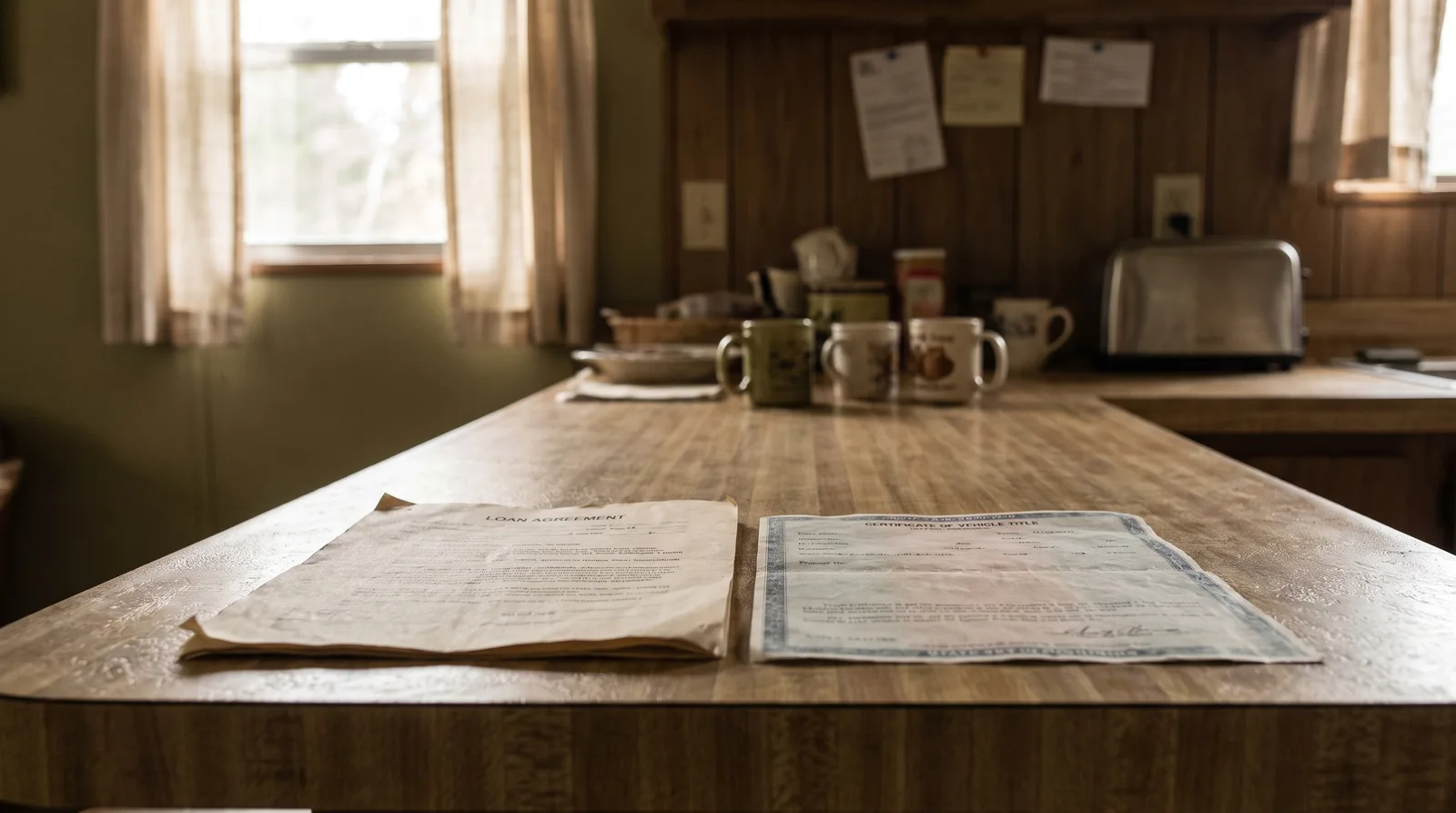
Every financing question about a mobile home resolves to one fact: is it titled as personal property or as real estate? One credit union's sheets this week quote home-only chattel loans at 9.09% to 9.59% APR while the same institution writes a 30-year mortgage at 6.74%. The real-property programs pay mortgage rates but demand a permanent foundation, land in the loan, and a factory-applied label your used single-wide will never have. Below the published minimums of $20,000 and $25,000 at the two biggest chattel lenders, there is nothing to apply for.
You want a loan on a mobile home. Most of what turns up is a lender landing page that never tells you which door you are standing at, so you apply, wait a week, and get declined for a reason nobody explains. Here is that reason, almost every time. A mobile home is either personal property or real estate, and that one legal fact sets your rate, your term, your maximum loan size, and whether an entire program will look at the home at all.
Chattel or Real Property: The Fork That Sets Everything
A chattel loan is secured by the home and nothing else. Legally the home is personal property, the same category as a boat, and it carries a certificate of title from a state agency rather than a deed at the courthouse. A mortgage is secured by real estate, the home and the ground under it as one parcel, recorded in county land records.
This is not a technicality affecting a few homes. The CFPB's analysis of national HMDA data found 42% of manufactured home purchase loans are chattel, and that for 72% of those the consumer does not own the land and is, in the CFPB's words, ineligible for a mortgage. Not declined. Ineligible, before anyone looks at credit.
Price the difference at one lender that publishes both. APG Federal Credit Union's mortgage rate sheet, effective September 4, 2026, quotes a 30-year fixed at 6.74% APR and an FHA 30-year fixed at 7.09% APR. Its manufactured home rate sheet, effective September 6, 2026, quotes home-only loans at 9.09% APR under $25,000, 9.34% from $25,000 to $49,999, and 9.59% at $50,000 and above. Same institution, same week, and the chattel product costs roughly two and a half points more at the bottom of its band and nearly three at the top.
Term compounds it. The CFPB found chattel borrowers carry a median term of 23 years against a plurality of 30 for mortgage borrowers. Higher rate, shorter term, larger payment.
Nothing about the building determines this. Two identical homes off the same line, one deeded to owned land and one on a rented pad with a state title, are different asset classes to a lender. You are not financing a structure. You are financing a legal category.
What it takes to convert a home to real property
Homes do move between the columns, under conditions most park homes fail. The National Consumer Law Center's survey of state titling law finds roughly three-quarters of states have a statute for the conversion, and the procedure generally means surrendering the certificate of title, then recording an affidavit of affixture in the county land records. Typically the home must be permanently affixed to the land, and many states also require the homeowner own that land. Some states allow conversion on rented land but demand a long-term leasehold, often 20 to 35 years.
Read that against an actual park. You do not own the dirt, your lease is month to month or annual, and no park manager grants a 25-year lease so a resident can retitle a home the park would rather keep as removable personal property. Conversion is a genuine option when you buy land with the home. On a rented lot it is close to unavailable, and any guide telling you to "just convert it to real property" has not read your lease.
FHA Runs Two Programs, and They Are Not Versions of Each Other
People say "FHA loan" as though it means one thing. For manufactured housing it means two, and only one of them will touch a home on a rented lot.
Title I: the right idea, at almost zero volume
Title I insures loans on the home alone, which is exactly what this market needs, and its limits were just rewritten. The 21st Century ROAD to Housing Act, signed into law July 11, 2026, amended 12 U.S.C. 1703(b) so a Title I manufactured home loan is now capped at $106,405 for a single-section and $195,322 for a multi-section, with $149,782 and $238,699 for home-and-lot combinations and $43,377 for a lot loan, up from $23,226. It also replaced the old fixed maturity schedule with a term set by the Secretary, "not to exceed 30 years."
Do not assume a lender is using those figures yet. HUD's own Title I page still links an Allowable Loan Parameters table dated March 2024, setting the limits at $105,532 single-section and $193,719 multi-section and capping a home-only loan at 20 years plus 32 days. Until HUD publishes updated parameters, that older table is what an FHA-approved lender underwrites to.
Two conditions matter more than any limit. First, HUD states the program is for buyers who plan to use the manufactured home as their principal place of residence. An investment unit is out, so Title I is never your acquisition financing. It is potentially your buyer's.
Second, the volume. The Urban Institute's comment letter to FHA and Ginnie Mae reports annual Title I originations ran 15,000 to 25,000 loans in the mid-1980s and early 1990s, fell to 1,572 in 2008, and reached 3 loans in 2021. Three, nationwide, the year 106,000 new manufactured homes shipped. Part of why: Title I required a leased site to carry a lease of at least three years, a statutory rule Urban said made the program "virtually impossible" in communities, since no state requires three-year leases and few parks offer them. The 2026 law struck those subparagraphs and handed the terms to HUD. Whether that revives anything is unknown, and nobody should plan a deal around it.
Title II: a real mortgage, with real-estate requirements
Title II is FHA's ordinary mortgage insurance applied to a manufactured home, and the eligibility list explains itself. Per HUD's Title II guidance, the unit must be constructed after June 15, 1976 to the federal construction and safety standards, sit on a permanent foundation built to FHA criteria, be classified as real estate, have a floor area of not less than 400 square feet, and the mortgage must cover both the unit and its site. For a park home that last clause ends it. There is no site in your loan, so there is no Title II.
MH Advantage and CHOICEHome: Good Programs, Wrong Homes
Search "fannie mae mobile home loans" and you land on MH Advantage, or Freddie Mac's CHOICEHome. Both are real conventional mortgages with down payments as low as 3%, and both are close to irrelevant to a $10,000 used single-wide, for a reason that is structural rather than a matter of shopping harder.
Eligibility is not a judgment an appraiser makes in the field. Fannie Mae requires the lender to confirm it by reviewing appraisal photos showing the MH Advantage sticker or the CHOICEHome label, placed near the HUD Data Plate. That sticker goes on at the factory, by a participating manufacturer, before the home ships. A home that left the plant without one cannot acquire one later at any price.
What the label certifies, per Fannie Mae's guide and Freddie Mac's CHOICEHome requirements:
- A masonry or poured concrete perimeter foundation, engineered and certified by a registered architect or engineer
- A low-profile set, with the finished floor no more than 30 inches above grade
- A covered porch of at least 72 square feet, plus an attached garage or carport
- A paved driveway and a sidewalk in comparable materials connecting it to the front entrance, and gutters directing water off the foundation
- Distinctive roof treatment with eaves and a higher pitch, and durable siding and cabinetry
- For CHOICEHome, minimum insulation of R-33 ceiling, R-11 wall and R-22 floor, exceeding HUD Code energy requirements
Then the title. Freddie Mac requires a manufactured home to be titled as real property and permanently affixed to a foundation to be eligible for sale to Freddie Mac, and on leasehold land a single-section home is not eligible at all, while a multi-section needs Freddie's written approval first.
Hold that list next to a 1997 single-wide on lot 42 with aluminum skirting and a gravel pad. No factory sticker, no masonry perimeter, no garage, no sidewalk, chattel title, rented ground, single-section. It fails on nearly every line before credit is pulled. These programs make new factory-built homes on owned land finance like site-built houses, and at that they work. They were never aimed at used inventory in a land-lease community.
Who Actually Writes Chattel Loans
The chattel market is small and concentrated. The CFPB found the top five manufactured-housing lenders account for nearly 75% of home purchase chattel loans in HMDA. In practice: 21st Mortgage, Triad Financial Services, a few regional banks, the occasional credit union.
On rates, be careful what you believe. Neither national chattel lender publishes a rate sheet, so any specific number attributed to them without a link is a guess. Triad's own chattel explainer puts them at "typically 7-12%+" against "typically 6-8%" for a traditional mortgage, with terms of 15 to 25 years. That is a range from the lender, not a quote. The verifiable numbers come from credit unions, which is why the comparison above uses one.
Price, repairs, resale, down payment, rate and term in. Monthly payment, cash-back month and annualized return out.
Open the free calculatorThe Floor Nobody Finances
Put the two published floors side by side: $25,000 at 21st Mortgage, $20,000 at Triad. A home priced under those does not get a hard decision. There is no application. And the condition rule closes the door on most of what sits just above them, because a cheap used single-wide is cheap for exactly the reasons 21st Mortgage lists as disqualifying: the roof, the floor, the plumbing.
This is not a manufactured-housing quirk. It happens to every cheap house in America. The Urban Institute found that in 2019 only 23.2% of homes priced below $100,000 were purchased with a mortgage, against 73.5% at or above $100,000. Small loans also get refused more: the denial rate on mortgages up to $70,000 in 2017 was 18%, double the 9% on loans above $150,000, and Urban's finding is that creditworthiness does not explain the gap. The return on a small loan does not justify originating it.
Be suspicious of anyone who cheerfully quotes you on a $12,000 home. Either it is an unsecured personal loan at a rate that eats the deal, or they are collecting your information to sell.
Which Is Why You Become the Financing
So the real answer to "how do I finance a $12,000 single-wide" is that you do not, and neither does the person you eventually sell it to. That is not a hole in your research, it is the structure of the market, and that vacuum is not a problem to route around. It is the margin.
The model is cash in, note out. You buy for cash because nothing lends at that price. You do the repairs 21st Mortgage would have required and no lender would have funded. Then you sell to a buyer already turned down everywhere above, and carry the paper yourself. Your note is their financing, and there is no competing offer because there is no competing lender.
What you pay is the valuation guide. What you fix before resale is the flipping guide. The note itself, principal, rate, term, late fees, default and acceleration, belongs to the owner-financing guide, and that is the one to read before you write anything.
One federal limit before you get there: under 12 CFR 1026.36, a natural person seller-financing one property per 12 months may use a balloon, three or fewer requires a fully amortizing loan plus a good-faith ability-to-repay determination, and past three you are outside both exclusions. The owner-financing guide covers the thresholds and the SAFE Act licensing question properly.
This is educational content, not legal advice. Seller-financing rules, usury caps and licensing thresholds vary by state and change, so have a local attorney confirm how they apply to you before you write a note.
Common Questions
A chattel loan is secured by the home only, which the law treats as personal property with a state-issued title. A mortgage is secured by the home and the land as one piece of real estate. The CFPB found 42% of manufactured home purchase loans are chattel, and for 72% of those the borrower does not own the land and is ineligible for a mortgage at all.
Title II, no: it requires the mortgage to cover both the unit and its site. Title I does insure home-only loans on leased sites, but only for buyers using the home as a principal residence, and the volume is effectively nil, with the Urban Institute counting 3 originations nationwide in 2021. The 2026 ROAD to Housing Act raised the limits and lifted the maturity cap to 30 years, but HUD's program page still links a March 2024 parameters table.
Through MH Advantage, and only for homes carrying an MH Advantage sticker or CHOICEHome label applied at the factory by a participating manufacturer. The spec behind that label includes a masonry perimeter foundation, a covered porch of at least 72 square feet, an attached garage or carport, and a paved driveway and sidewalk, and the home must be titled as real property. A used single-wide on a rented lot cannot qualify, and cannot be made to qualify later.
Among national chattel lenders, Triad publishes a $20,000 minimum and 21st Mortgage a $25,000 minimum. Below that there is no institutional product, and above it the condition requirements knock out most cheap used inventory anyway, since 21st Mortgage will not finance homes needing repairs. It is the same pattern as the wider market, where only 23.2% of homes under $100,000 were bought with a mortgage in 2019.