
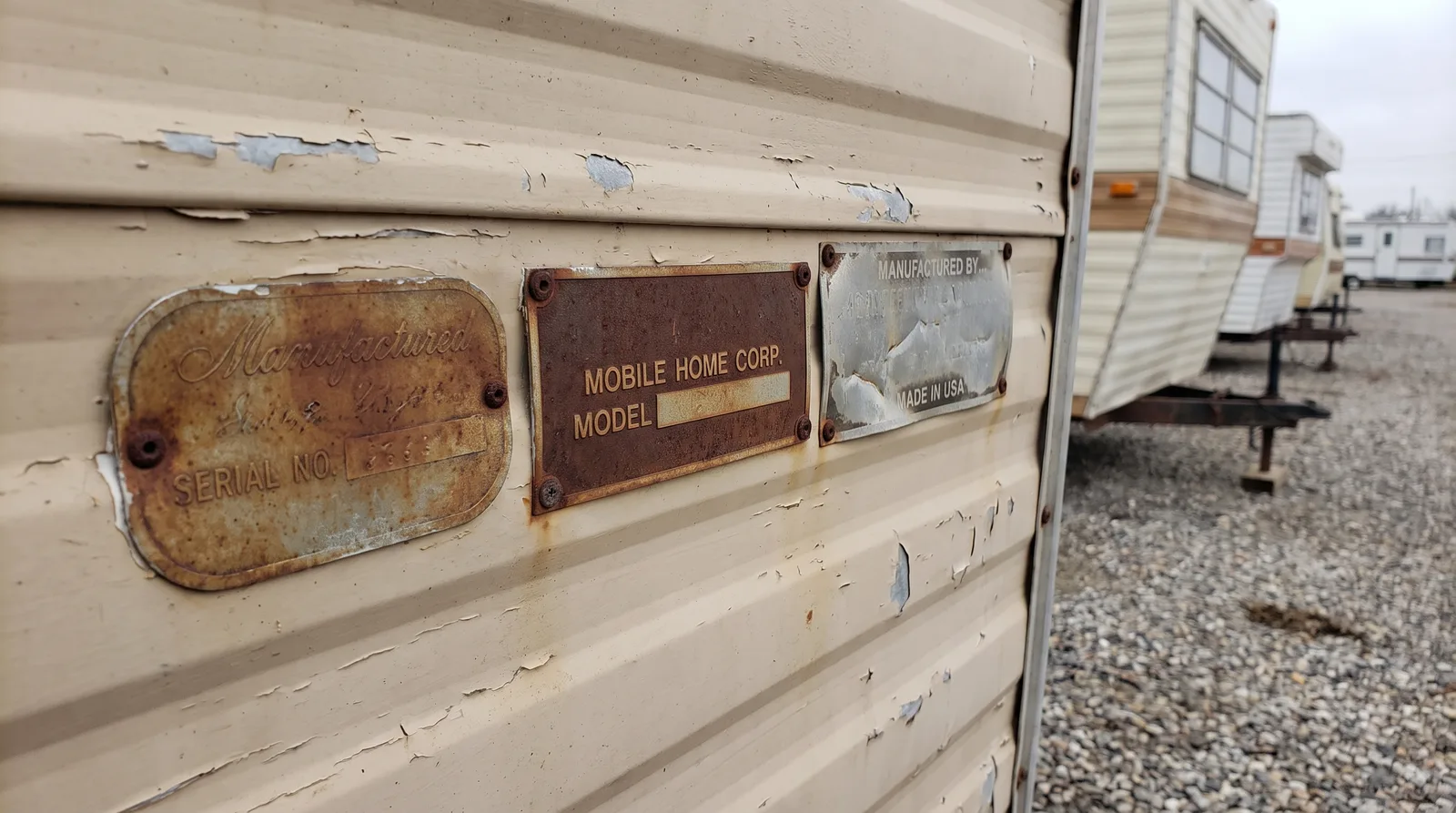
Three companies build almost the entire market. In the first quarter of 2026, Clayton Homes produced 46.4% of US HUD-code homes, Champion Homes 22.8% and Cavco 17.2%. Clayton belongs to Berkshire Hathaway. Champion traded as Skyline Champion until August 2024. Palm Harbor has been a Cavco nameplate since 2011, retired as a factory brand in 2025. On a used home the badge is the fifth thing that sets your number, behind HUD-code era, condition, size and location.
Comparing builders is a reasonable way to spend an afternoon if you are buying new off a dealer lot. If you are buying a 1998 single-wide out of a park for $6,000, it is close to the least useful question you can ask, and the answers online are worse than useless because the corporate map moved underneath them. Plenty of "best mobile home brands" pages still name companies sold in bankruptcy court fifteen years ago, or a public company under a name it dropped in 2024. Here is the map as it stands in 2026, and where the badge really sits.
Who actually owns these names in 2026
Clayton: Berkshire Hathaway, and it is not close
Clayton Homes, Inc. sits near Knoxville, Tennessee and is wholly owned by Berkshire Hathaway. Berkshire's 2025 annual report calls it "a vertically integrated housing company offering off-site (factory) and site-built homes, including modular, manufactured, CrossMod, town homes and tiny homes." In 2025 it shipped roughly 49,400 factory-built homes on revenue of $12.9 billion. Vertically integrated is the part that matters: Clayton builds the home, sells it through company-owned and independent home centers, and lends against it. Berkshire says Clayton "considers its ability to offer financing to retail purchasers a factor affecting the marketplace acceptance of its off-site built homes."
The brand names are where people get lost. Clayton spent two decades buying nameplates and the last few years erasing them. In April 2020 it folded its Cavalier plant and its Southern Energy plant in Addison into one facility it named Clayton Alabama. Its plant directory today reads Clayton Albany, Clayton Sacramento, Clayton Hermiston. City names, not brand names.
One trap worth knowing. Clayton bought the old manufactured-housing company Oakwood Homes out of bankruptcy for about $373 million cash, announced November 25, 2003. In 2017 it bought an unrelated Colorado site-builder also called Oakwood Homes. Different company, different product, and searching the brand gets you both.
Champion: the company formerly known as Skyline Champion
Skyline Corporation and Champion Home Builders merged on June 4, 2018 into Skyline Champion Corporation, NYSE ticker SKY. On August 5, 2024 it renamed itself Champion Homes, Inc. The ticker is still SKY. Any page calling it Skyline Champion is two years stale, a quick way to judge whether a comparison article is maintained.
Before that, the old public Champion Enterprises, Inc. filed Chapter 11 in Delaware in November 2009. An investor group of Centerbridge Partners, MAK Capital and Sankaty Advisors put in $50 million and bought the operations on March 19, 2010 as Champion Enterprises Holdings, LLC. That is the entity that later merged with Skyline.
Champion still runs its nameplates rather than collapsing them. Its fiscal 2026 annual report lists homes built under Champion Homes, Genesis Homes, Skyline Homes, Regional Homes, Athens Park, Dutch Housing, Atlantic Homes, Excel Homes, Homes of Merit, New Era, J. Redman Homes, ScotBilt Homes, Shore Park, Silvercrest and Titan Homes in the US, plus Moduline and SRI Homes in western Canada. That is 46 plants and 84 retail centers behind seventeen badges.
Cavco, and what happened to Palm Harbor
Palm Harbor Homes used to be its own public company. How it stopped being one explains how badges move here. In 2009 Cavco and the Third Avenue Value Fund set up a jointly owned company, FH Holding, and bought Fleetwood Enterprises' manufactured housing business out of Chapter 11. A bankruptcy judge approved the sale on August 12, 2009 for $26.6 million. Read what was in the box: "seven operating manufactured housing plants, one office building, one idled plant, all related equipment, inventory, certain trademarks and trade names, intellectual property." Trade names are an asset. They get sold.
That same Cavco/Fleetwood entity then took Palm Harbor. A filing by Palm Harbor's departing chairman puts it plainly: "The Cavco/Fleetwood purchase of Palm Harbor Homes, Inc. of Florida was completed on Monday, April 25, 2011." Then Cavco did what Clayton did.
From its fiscal 2025 annual report: "In the fourth quarter of fiscal 2025, the Company modified its extensive manufacturing brand lineup by changing all of its various trade names to a new, unified brand under the Cavco name, followed by the city it's located in." So Palm Harbor is no longer a factory brand. It survives as a Cavco legal entity and a retail name, and palmharborhomes.com is still live in 2026 telling shoppers that "Cavco Homes are proudly offered at Palm Harbor Village."
Cavco also bought American Homestar, best known as Oak Creek Homes, effective September 29, 2025 for $190 million. As of March 28, 2026 it ran 33 production lines and 92 company-owned stores, 57 of them in Texas.
This is why a badge is not a builder. A Fleetwood plate on a 2007 home and one on a 2015 home were screwed on by different companies. The name changed hands in a courtroom in between.
Three companies, 86% of the market
The Manufactured Housing Institute publishes quarterly production share. Its first quarter 2026 report puts Clayton at 46.4% with 11,080 homes, Champion at 22.8% with 5,440, and Cavco third at 17.2% with 4,094, against an industry total of 23,860. Add the three and you get 86.4% of everything built that quarter, which leaves 13.6 percent for everyone else. Champion's own filing agrees from the other direction: 22.5% US wholesale share of HUD-code homes in fiscal 2026, and roughly 85% for the top three in calendar 2025.
Concentration does three things to you, and none is about quality.
- Comps get easier. Most used homes you look at came from these three families or the ones they absorbed. Deep comp set, and it is why method beats brand shopping.
- Dealer and parts channels follow volume. Champion runs 84 retail centers, Cavco 92, and Clayton sells through both company-owned and independent centers. Regional builders with two points of share do not have that footprint, and dead ones have none.
- Financing sits in the same buildings. Clayton lends against its own homes, and Cavco owns CountryPlace, an approved Fannie Mae and Freddie Mac seller/servicer. Read your loan terms rather than take the first offered at the lot.
What actually moves the resale number, in order
Ranked by how much each moves your exit price on a used home:
The part nobody wants to write
There is no public dataset showing used resale value by brand. Not from HUD, not the Census Bureau, not the industry association. The manufacturer is an input to the paid depreciation guide, which prices off year, manufacturer, model, size and features, but the weight it carries is unpublished and nobody releases brand-level resale differentials. We looked. If that changes we will update this page.
Any page telling you a brand holds "15% more value" invented the number. It is not a hard figure to look up. It does not exist. Do what the valuation guide lays out instead: pull a baseline, then comp it against three to five real homes of the same age, size and section count in your county. Your comps price the brand for you, in your market, with nobody guessing.
Finding the builder when the badge is gone
On an older home the badge is usually long gone. The home still tells you who built it, in two places, for free. The data plate is a paper sheet inside, and HUD says it sits in a kitchen cabinet, an electrical panel, or a bedroom closet. It carries "the name and address of the manufacturing plant," the serial number, the model designation and the date of manufacture. The HUD certification label is the red metal plate outside, roughly 2 by 4 inches, one per section.
Note what the plate names: the plant, not today's owner of the trade name. A plate reading Fleetwood Homes, Riverside, California tells you where and when the home was built. Who owns that name now is a separate question. The full walkthrough on both tags, and what verification costs when they are missing, is in what is my mobile home worth.
Purchase price, repair budget, resale, note terms. Run those four and see the annualized return before you make an offer.
Open the free calculatorDead nameplates, and what they actually cost you
Fleetwood Enterprises, Champion Enterprises, Oakwood Homes and Palm Harbor Homes were all independent companies that stopped being independent companies. Buy 1990s and 2000s homes and you will see all four badges. What that does and does not mean:
Warranty: irrelevant either way. The one most people get backwards. Cavco's annual report describes what a retail buyer gets: "a one-year limited warranty covering defects in material or workmanship in home structure, plumbing and electrical systems," with cosmetic components "generally warranted for 120 days." A 1998 home is out of warranty whether or not its maker still exists. Do not pay a premium for a living brand on the theory that someone will stand behind a twenty-eight-year-old home.
Parts: commodity items fine, fitted items not. Furnaces, water heaters, faucets and roofing come from the same national suppliers whoever assembled the home. The awkward category is maker-specific. Berkshire's report notes Clayton builds with "components like windows, interior doors and cabinets manufactured by its supply division," which is exactly the list that is hard to match on an older home from a company that no longer runs a supply division. Budget a workaround for exact-fit windows and cabinet fronts, not a factory reorder.
Financing: the manufacturer being gone changes nothing. A lender underwrites the build date, the tags and the title, not whether the badge is a going concern. A dead badge is a negotiating point, not a disqualifier. If the seller thinks the brand is worthless because the company folded, let them, and price the roof.
The current three, side by side
Be careful what you conclude about price tier. All three publish lineups running from budget to premium: Clayton calls its TRU line "our most affordable home" while also building CrossMod and modular, Champion calls itself the number one modular builder in the US, and Cavco builds park models and cabins. Tier tracks the model line, not the badge.
| Builder | Who owns it now | Where new ones are sold | Q1 2026 share | What a used one means for you |
|---|---|---|---|---|
| Clayton | Berkshire Hathaway, wholly owned | Company-owned and independent home centers, realtors, subdivisions | 46.4% | The badge you see most often, so the deepest comp set. Cavalier and Southern Energy are Clayton plants now. |
| Champion | Public, NYSE: SKY, renamed from Skyline Champion in 2024 | Independent retailers plus 84 company retail centers | 22.8% | Seventeen live nameplates in one family. Plant and year tell you more than the badge. |
| Cavco | Public, Nasdaq: CVCO | Independent distributors plus 92 company stores, 57 in Texas | 17.2% | Palm Harbor, Fleetwood and Oak Creek badges are all this company. Strongest in Texas and the West. |
| Everyone else | Regional and private builders | Local dealers, varies by state | 13.6% | Thinner dealer support and comps. Not a reason to walk, a reason to comp harder. |
The honest verdict
If you are buying a $6,000 used single-wide, the badge should change your offer far less than the roof, the subfloor and the park. Those three are worth thousands each and you can inspect them in an afternoon. The brand is worth some buyer familiarity at resale, cannot be measured from public data, and is the only one of the four you cannot change. One exception: if your exit buyer needs a lender and the tags are missing or the build date is wrong, the deal breaks regardless of who built it. That is a paperwork problem wearing a brand costume, and it is fixable before you buy, not after.
So run the order of operations. Confirm the build date, walk the four condition items, count the sections, judge the park, and last, notice the badge. Put the numbers into the free Deal Calculator and read the annualized return. If the spread only works because you talked yourself into a premium for the nameplate, it does not work.
Common Questions
No public data answers that for used homes, and anyone quoting you a percentage is inventing it. What is documented is scale: Clayton produced 46.4% of US HUD-code homes in the first quarter of 2026, Champion 22.8% and Cavco, which owns the Palm Harbor name, 17.2%. Scale buys comps and dealer coverage, not a resale premium.
Cavco Industries. The Cavco and Fleetwood entity completed the purchase of Palm Harbor Homes, Inc. on April 25, 2011. In the fourth quarter of fiscal 2025 Cavco retired its legacy factory trade names and renamed its plants Cavco plus the city. Palm Harbor survives as a legal entity and a retail name, and palmharborhomes.com is still live.
Same company, new name. Skyline and Champion Home Builders merged on June 4, 2018 into Skyline Champion Corporation, which renamed itself Champion Homes, Inc. on August 5, 2024. It still trades on the NYSE under SKY, and Skyline Homes remains one of its brands.
For commodity items, easily: furnaces, water heaters, plumbing fixtures and roofing were never brand-specific. The harder category is fitted components, the windows, interior doors and cabinet fronts built in a manufacturer's own supply division to its own sizes. Plan a workaround, not a factory reorder.
No. Lenders underwrite the build date, the HUD tags and the title status. Homes built before June 15, 1976 are rejected for FHA insurance with no exceptions, and that applies to every brand equally. A defunct manufacturer with a clean post-1976 data plate and clean title finances the same as a company still in business.