
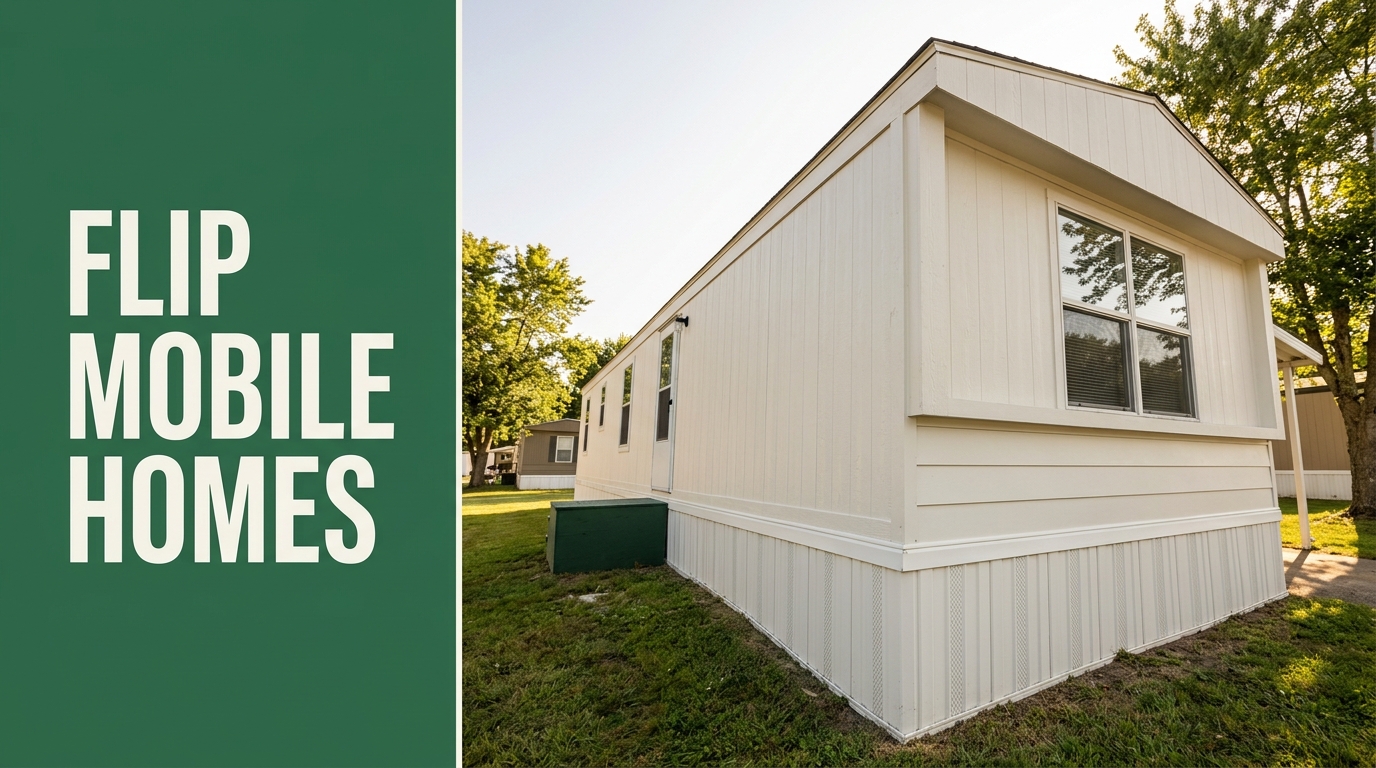
Yes, you can flip mobile homes for profit. Investors buy distressed or underpriced units, put money into targeted repairs, and sell at a markup, often for $10,000 to $40,000 in gross profit per deal depending on the market, the land situation, and how fast the home sells.
Mobile home flipping works on the same basic logic as any other buy-low, fix, sell-high play. The difference is the entry price, the buyer pool, and a handful of structural factors that make the math behave differently than a single-family flip. Whether a deal is worth doing comes down to four things: what you pay, what you spend on repairs, what carrying costs eat up while you wait to sell, and what price the market will actually bear when you list it.
The Math: What Actually Determines Whether a Flip Works
Strip away the excitement and a mobile home flip is an arithmetic problem. Say you buy a unit in a park for $5,000 cash. You spend $3,500 on repairs, cosmetics, and supplies. You carry two months of lot rent at $450 per month, plus utilities, while you sell. That is $900 in carrying costs before you close. Your total into the deal is now $9,400. If the market in that park supports a retail sale price of $22,000, your gross margin is roughly $12,600. That is a workable deal. If your repair scope balloons to $8,000 and the home sits for four months instead of two, your margin shrinks by more than half before you factor in any sales costs.

Running those numbers before you commit is not optional. It is the whole job. A deal calculator built for mobile homes, not borrowed from a single-family spreadsheet, keeps the inputs honest because the cost categories are different.
Flipping on Rented Land vs. Land You Own
The single biggest structural variable in any mobile flip is whether the home sits on land you own or on a rented lot in a park. Each path has different numbers and different risks.
When you flip inside a park, you pay monthly lot rent from the day you take title until the day you sell. That fee runs anywhere from $300 to $600 or more per month depending on the park and the region. It does not pause because your buyer fell through. Park rules also govern who can buy in, what financing the community allows, and sometimes whether a cosmetic renovation needs approval. You need the park manager on your side before you close, not after.
When you own the land under the home, you carry property taxes and any mortgage on the dirt, but you have more control over the sale price and buyer financing options. Land-plus-home deals also tend to appeal to a wider buyer pool, including some conventional and FHA lenders, which opens up the market. The tradeoff is a higher acquisition cost and a longer sales cycle in some areas.
The Holding-Cost Trap
Holding costs are the silent killer in mobile flips. Investors who lose money on otherwise good deals almost always made the same mistake: they priced the deal assuming a 30-day or 60-day sale, and the home sat for 90 or 120 days instead. Every extra month adds lot rent or land carrying costs, utilities if the home is connected, and insurance. None of those costs show up in a before-and-after photo of the renovation.
The fix is to build a realistic sale timeline into your numbers from day one, and to have a backup plan if the home does not sell at your target price within that window. That backup plan is usually owner financing, which brings us to the next decision every active flipper eventually faces.
Flip or Finance: Choosing the Right Exit
Most investors who do more than a handful of mobile home deals figure out that flipping and owner financing are not competing philosophies. They are different tools for different situations. A flip is right when you need the cash back quickly, when the buyer pool in that park or area is deep, or when you have another deal waiting and need your capital freed up.
Owner financing makes more sense when a home is not moving at retail, when your buyer cannot qualify for traditional lending, or when the monthly payment income is worth more to you over time than a lump-sum profit today. Selling a home for $18,000 with $2,500 down and $350 monthly payments over five years produces more total cash than a clean $12,000 flip profit, even before you count the interest.
The pivot point is usually this: once a flipper has two or three deals going at the same time and cash flow becomes as important as lump-sum gains, owner financing starts winning the comparison more often. It is not a retreat from flipping. It is a sign the investor is thinking about the portfolio, not just the next check.
What Repairs Actually Move the Needle on Price
Not every dollar you put into a mobile home comes back out at resale. Some repairs are non-negotiable for a sale to happen at all; others add perceived value that actually lifts the price. The rest just drain your margin.
- Roof condition: a soft or leaking roof will kill a deal before a buyer even walks in. Fixing or resealing it is usually worth the cost because it removes the biggest objection.
- Subfloor repairs: soft spots and damaged floors are felt immediately and priced hard into any offer. Addressing them is a margin protector, not a luxury.
- Fresh paint inside and out: the highest return-per-dollar renovation in almost every mobile flip. Clean neutral color reads as 'cared for' to buyers who are comparing against other park inventory.
- Skirting: new or repaired skirting changes the curb impression fast. It is inexpensive and signals a maintained home from the road.
- Kitchen and bathroom cosmetics: clean, functional, and not dated sells faster than a full gut renovation at a higher price point that the market may not support.
- HVAC function: a working heater and air system is a prerequisite in most markets. Buyers do not pay a premium for a working system, but they will walk away from one that does not work.
What rarely pays off in a flip: adding square footage, full kitchen gut-outs, luxury flooring, or any upgrade that prices the home above what comparable units in the same park have sold for. Know the ceiling in your specific park or area and renovate to just below it, not past it.
Fall Market Timing and What It Changes
September and the months that follow bring a real shift in mobile home buyer behavior. The summer rush, when families with school-age kids move between May and August, is over. Fall buyers tend to be smaller households, retirees, and individuals motivated by something other than a school calendar. That buyer profile is often more decisive and less likely to negotiate from a position of leisure.
Fall is also when motivated sellers become easier to find. Park residents who wanted to be gone by summer but could not move fast enough will accept lower prices rather than carry a vacant home through winter. That is where flip deals come from. The tradeoff is that your own resale window before the holiday slowdown is shorter, which makes holding-cost math even more important when you are writing an offer in September or October.
Lot availability can also shift in fall. Parks that were full in July sometimes have vacancies open up as seasonal residents leave or as the park turns over units it has reclaimed. A good relationship with a park manager is worth more in fall than in any other season.
Selling the Home Is the Other Half of the Job
A renovated mobile home sitting in a park is not a sale. It is an asset waiting to become one. First-time flippers often underestimate what it takes to find a qualified buyer and move them through to a signed contract and a funded close.
The buyer pool for park-based mobile homes skews toward cash buyers and owner-financed buyers, not mortgage-backed purchasers. That means you need to know before you buy who your likely buyers are, what they can actually pay, and how you will reach them. Signs in the park, Facebook Marketplace listings with real photos, and word of mouth with the park manager are all tools that move homes. Waiting for buyers to find you on Zillow alone is not a complete strategy.
The investors who flip consistently are the ones who have a sales process running alongside the renovation, not one that starts after the paint dries.