
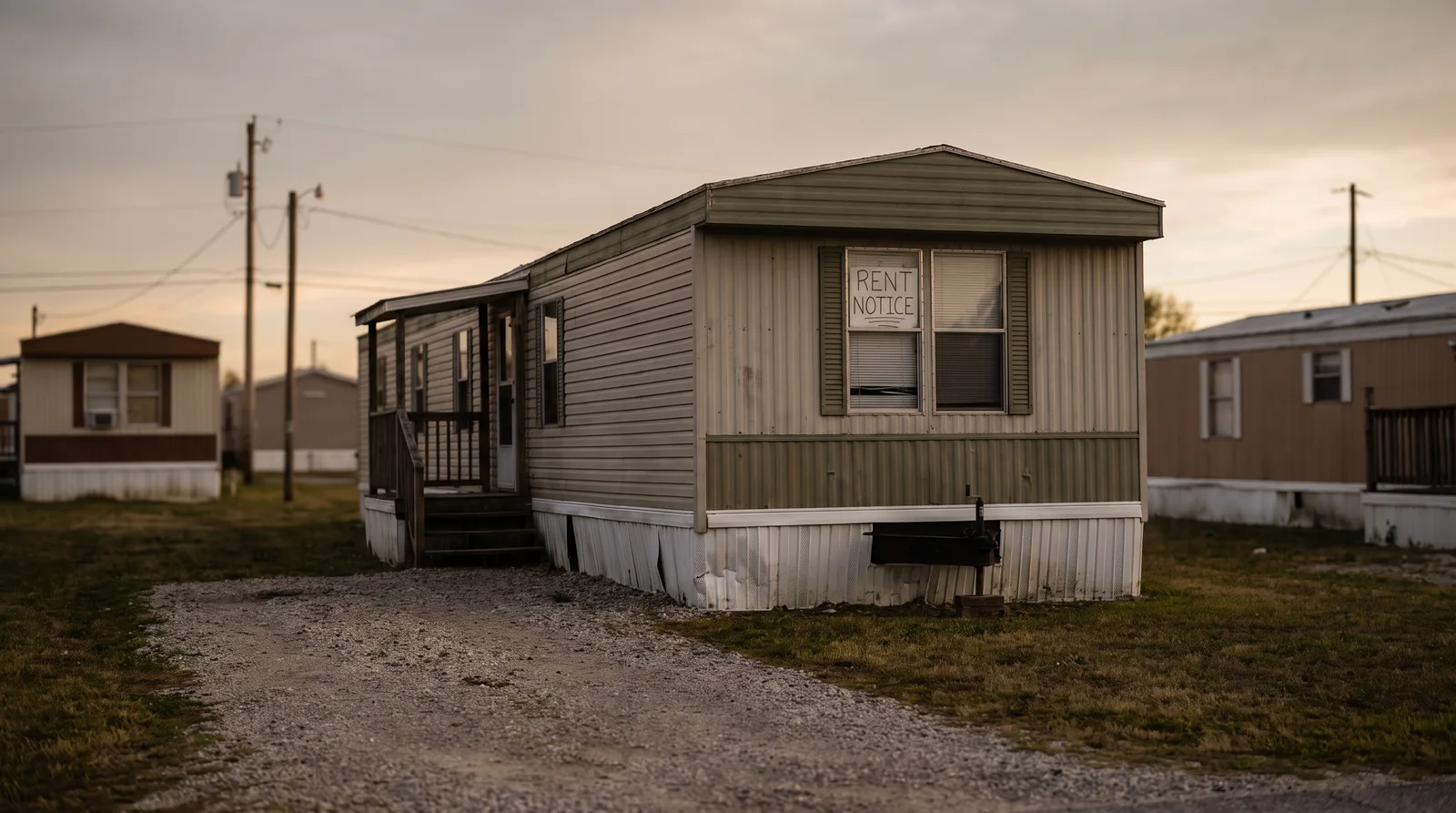
The home is a bad investment. The note is a good one. A used mobile home on a rented lot is a depreciating box on land you do not control, and lenders price it that way: a published credit-union rate sheet today quotes 8.89% to 9.39% on a home-only loan against 6.71% for a 30-year mortgage, and 50% of chattel applications get denied outright. What makes money in this business is not owning the home. It is the note you create when you resell it with owner financing, and a note does not depreciate.
If you searched "why mobile homes are a bad investment," you were probably about to spend money and wanted someone to talk you out of it. Good instinct. Most of what you will find is either a sales page pretending the downsides do not exist or a scare piece that never reaches the part where the math works.
Most of the confusion starts with treating "mobile home investing" as one thing. It is three things, and they behave completely differently.
- The box. The structure itself. It loses value. This is the part the skeptics get right.
- The note. The loan you create when you sell that home with owner financing. It does not lose value. It is a contract that pays a fixed amount every month.
- The land. The park underneath. It does not lose value either, which is exactly why institutional money buys parks and not individual homes.
Buy a mobile home and hold it, and you own the worst of the three. Buy one cheap, fix what matters, and resell it on a note, and you have converted the worst asset into the second-best one. That trade is the entire business.
The Case Against, With Actual Numbers
None of this is softened. If any one of these is a dealbreaker for you, it should be, and you should stop here.
The home does not hold value the way land does
The most-cited defense of manufactured housing is an Urban Institute analysis of FHFA data published in November 2024. From 2000 to 2024, site-built homes appreciated 212.6% and manufactured homes appreciated 211.8%, about 5% a year for both. Anyone selling you on this asset class will quote that.
Read the fine print. That analysis only covers manufactured homes where the borrower owns the land, because Fannie Mae and Freddie Mac only buy those loans. The authors say the quiet part out loud: "the value of manufactured housing on land the borrower does not own has likely not performed nearly as well." The home you would buy in this business is precisely that home, chattel-titled on a rented lot, excluded from the study that says manufactured homes appreciate. MHInsider's 2026 State of the Industry report puts the average new manufactured home at $115,557 in 2025 and the average existing one at $73,326.
Appreciation follows the dirt, not the drywall. A manufactured home bolted to owned land tracks the housing market. The same box on a rented lot tracks something closer to a used-vehicle curve. Identical home, different asset.
Borrowing against one costs materially more
A loan secured by the home but not the land is a chattel loan, and it prices like personal property because that is what it legally is. The CFPB's 2021 report on manufactured housing finance put the 2019 median rate on chattel loans at 8.6%, against 4.9% for manufactured-home mortgages and 4.1% for site-built. More telling: 93.8% of chattel originations were classified as higher-priced mortgage loans, against 11.1% of site-built. That is not a handful of bad-credit outliers. That is the product.
The gap has not closed. APG Federal Credit Union's published rate sheet, effective September 3, 2026, quotes home-only loans at 8.89% under $25,000 and up to 9.39% above $50,000. Freddie Mac's survey that same day put the 30-year fixed mortgage at 6.71%. Two to three points of spread, on shorter terms, on a smaller balance.
Half the applications get denied, and the cheap homes never get one filed
The same CFPB report found that 42% of all manufactured-housing purchase applications were denied in 2019, including 50% of chattel applications, against just 7% of site-built applications. Only 27% of manufactured-home applicants ended up with a loan, versus 74% of site-built applicants.
Then there is the floor. The median chattel loan in that data was $58,672. National lenders set minimums well above what a cheap used unit costs: 21st Mortgage, the largest chattel lender in the country, requires a minimum loan of $16,000 through a dealer and $25,000 for a private-party purchase or refinance, per Credit Karma's review of its terms. The $6,000 single-wide you are looking at is below every institutional floor in the market. Nobody will finance it, including for you. That cuts both ways, and it is the hinge of the whole business: it is why you buy with cash, and it is why your buyer has nowhere else to go.
You do not control the lot rent
You own a home on somebody else's dirt. MHInsider's 2026 report puts the 2025 national average site rent at $782 a month, $751 in all-age communities and $841 in 55-plus communities, and reports site rents rose an average of 6% in 2025. Sustained, 6% a year roughly doubles a lot payment in twelve years.
That matters more to you than to a homeowner. A lot rent increase does not land on you. It lands on your buyer, whose budget is the lot rent plus your note payment. Push their housing cost high enough and the payment that stops is yours, not the park's. You are the junior claim on a household budget you cannot see.
Moving the home is not the escape hatch
People assume a mobile home is mobile. It is, once, expensively. This Old House puts the national average at about $6,500 for a single-wide and $11,500 for a double-wide including transport and setup. On a home worth $10,000, relocation can cost most of the asset, and that assumes another park will accept it, which older units frequently fail.
The rules can move under you
Washington's HB 1217, effective May 7, 2025, caps annual lot rent increases at 5%, bars any increase in the first twelve months of tenancy, and requires three months of written notice. In December 2025 the Joint Economic Committee's ranking member opened an investigation into six corporate owners of manufactured housing communities over rents, fees, evictions, and maintenance. Most of that movement protects residents, which protects your buyer and constrains park owners. The direction of travel is the point: rules you did not underwrite can change the economics of a park you already sold into.
Why the Model Persists Anyway
Everything above is true and the business still works, because the demand underneath it is structural rather than a trend.
Manufactured homes are the cheapest unsubsidized housing in America. The Manufactured Housing Institute puts a new manufactured home at $84 per square foot against $169 for site-built, and NAHB found $86.62 versus $165.94 in 2023 excluding land, roughly $118,980 of difference on a 1,500-square-foot home.
Supply has not kept up. Manufactured homes were 9.0% of single-family home starts in March 2026 per MHI's economic report, with shipments down 5.2% year over year. NAHB has the share stuck at 9% to 10% of new housing since 2008, down from 17% to 24% in the 1990s.
Now put that next to the 50% chattel denial rate. A large pool of people can afford a monthly payment on the cheapest housing available and cannot get a loan to buy it. That mismatch is not a market failure you have to fix. It is the demand you sell into.
The Note Is the Asset, Not the Home
You are not buying a mobile home to own a mobile home. You are buying it to manufacture a different instrument.
The sequence is short: buy well under market for cash, because nothing will finance a unit that cheap. Spend only on repairs that protect resale value. Then sell with owner financing to a buyer the banks already turned away, collecting a down payment and the spread at closing and fixed monthly principal and interest for years after. The buying and repair mechanics are in the flipping guide; pricing the unit before you make an offer is in the valuation guide.
Owner financing is the half that changes the character of the investment. The owner-financing guide walks the note structure line by line, but the short version is that a note is a fixed contract at a fixed rate for a fixed term. It does not care that the roof aged a year. It is worth what the payment stream is worth, and it can be sold to a note buyer if you want your capital back early.
That is the honest reframe. The home is a depreciating input. The note is the output, and the output is the thing you own.
The note only holds up if the buyer keeps paying, and they only keep paying if total housing cost stays affordable. Park quality and lot rent trajectory belong in your underwriting, not just the home's condition. A great home in a park raising rent 8% a year is a worse note than an average home in a stable one.
Purchase price, repairs, resale, down payment, rate and term. It shows the monthly payment, cash-back month, and annualized return.
Open the free calculatorWhat About Buying a Park Instead?
"Are mobile home parks a good investment" is a different question with a different answer, and it explains why so much institutional money sits in this sector. The park owner holds the land, the roads, and the utility infrastructure. Residents own the depreciating boxes. Moving a home costs thousands, so tenants stay. Low turnover plus low expense ratios, and capital noticed.
It also takes a completely different amount of money. Broker data from Keel Team puts national average cap rates near 5.9% in early 2026, down from roughly 6.3% in 2024, with premium Sun Belt communities at 4% to 5%. Compressed cap rates mean you are bidding against funds, and 20% to 30% down on a seven-figure asset means a six-figure check before you fix a pothole. Read the park investing guide first. Almost nobody should start there.
One Legal Line You Cannot Skip
Federal rules cap how many owner-financed notes you can write before you are treated as a loan originator. Under 12 CFR 1026.36, a natural person financing one property in any 12-month period gets the loosest treatment, while financing three or fewer properties in that window requires the loan be fully amortizing and that you make a good-faith determination the buyer can repay. Past that you are outside both exclusions. The owner-financing guide covers the thresholds, the balloon restrictions, and the SAFE Act licensing question in detail, and it is not optional reading before you write a note.
This is educational content, not legal advice. Seller-financing rules, usury caps, and dealer-licensing thresholds vary by state and change, so have a local attorney confirm how they apply to you before you write anything.
Who Should Not Do This
A lot of people should read the case against, agree with it, and go do something else.
The Honest Answer
Is buying a mobile home a bad investment? As a thing to own and hold, on a rented lot, hoping it goes up: yes. Genuinely, measurably bad. It depreciates, it costs more to finance, it is harder to sell, and the ground rent under it is set by someone else who raised it 6% last year.
The business is not owning the home. It is being the only source of financing in a market where half the loan applications get denied and the cheapest units sit below every lender's minimum. You buy the depreciating asset cheaply, in cash, precisely because it is hard to finance, and you sell the thing that is genuinely valuable: a payment stream secured by a home somebody actually wants to live in.
Do that carelessly and you own a bad box and a bad note. Do it with the math done first, in a state whose rules you have read, with a buyer whose budget you have checked against the lot rent, and you own a fixed-rate income stream you originated at a discount. Same purchase, two very different outcomes. The difference is entirely in what you do after you buy.
Common Questions
No, and the distinction is the land, not the home. FHFA data analyzed by the Urban Institute shows manufactured homes on owned land appreciated 211.8% from 2000 to 2024, essentially matching site-built at 212.6%. That analysis excludes homes on rented land, which the authors say have "likely not performed nearly as well." The chattel-titled home in a park is the one that behaves like a depreciating asset.
Because a home-only loan is secured by personal property, not real estate, which makes it faster to originate and harder to recover on. CFPB HMDA data put the 2019 median chattel rate at 8.6% against 4.1% for site-built, with 93.8% of chattel loans classified as higher-priced. Published credit-union rates of 8.89% to 9.39% against a 6.71% 30-year mortgage show the pattern holding today.
For institutions, yes, which is why they own so many. The land does not depreciate, expense ratios are low, and tenants cannot cheaply leave. For an individual starting out, the entry cost is the problem: 20% to 30% down on a park priced off a 5% to 7% cap rate puts the check well into six figures. The park guide covers what that looks like.
Federal rules under 12 CFR 1026.36 draw the lines at one property and at three or fewer properties per 12-month period, with stricter structural requirements at the higher count, including fully amortizing terms and a documented ability-to-repay determination. Above that you are outside both exclusions. The owner-financing guide has the detail, and a local attorney should confirm it for your state before you write your first note.